How to identify channel catfish
Ictalurus punctatus · Ictaluridae
The characters that identify channel catfish, ranked by how far each one can be trusted on its own.
Safety: venomous and spined species — can cause serious injury or death. One more point applies here.
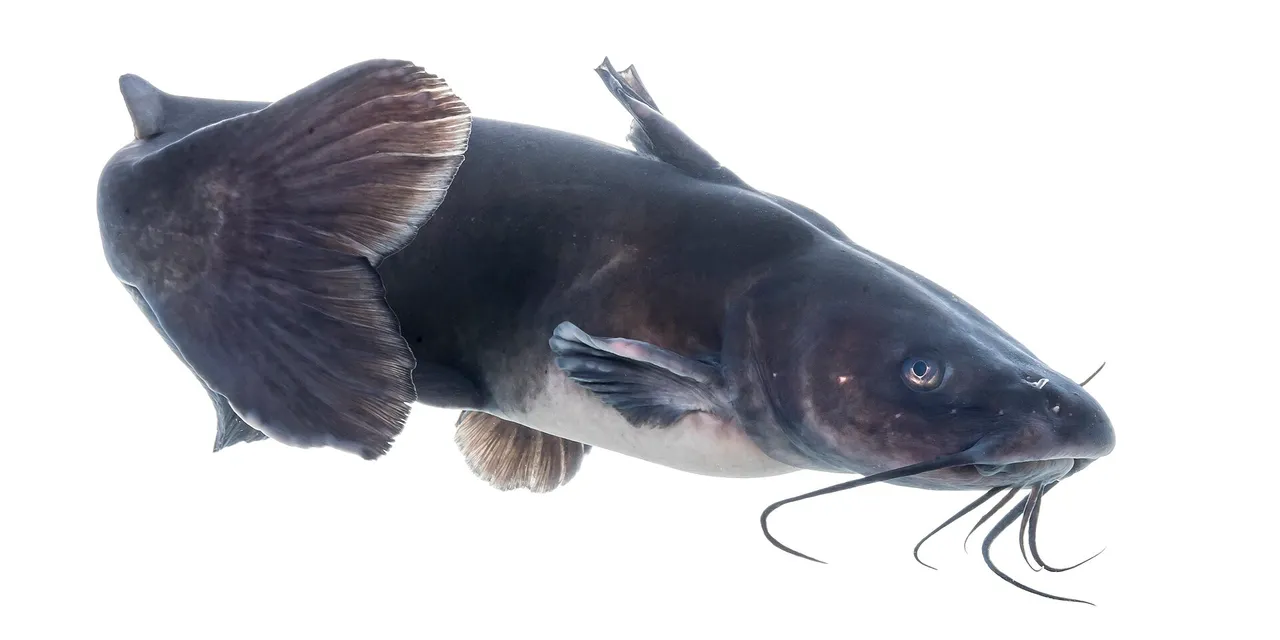
How this was identified, and who took it
Identified by: Whole fish on white. Deeply forked tail, barbels, adipose fin and the rounded free margin of the anal fin — the last being the character that separates it from blue catfish.USFWS Mountain Prairie — Public domain, via Wikimedia Commons — source, licenceLook at this first
Start at the tail. A deep fork means channel or blue catfish and rules out flatheads and bullheads immediately. Then look at the anal fin: rounded along its free edge is channel, straight-edged is blue.
Diagnostic — settles it on its own
Each of these settles the identification on its own. If one is clear, you have your answer.
A deeply forked tail
The two lobes are separated by a clean V. Bullheads have a squared or slightly notched tail and a flathead's is effectively square, so this one character removes most of the North American catfish in a glance.
The shape of the anal fin's edge
Curved and rounded rather than cut off straight, with fewer rays than a blue catfish carries. This is the separation from blue catfish and it is the character that matters most, because tail shape alone does not distinguish those two.
Supporting — use with other characters
Real characters that are not conclusive by themselves. Use two or three together.
Which jaw is in front
The upper jaw overhangs the lower slightly, giving the head a rounded snout in profile. A flathead is built the other way round and looks it. Easy to check on a fish in hand and easy to misread in a photograph taken from above.
Suggestive only — varies with condition
Hints only. These vary with condition, season, water and how long the fish has been out of it, and a fish that contradicts them is still the same species.
Spots on the flank
Small dark spots scattered along the sides of young and mid-sized fish. Here is why they are not diagnostic: large adults lose them entirely, and a big spotless channel catfish is misidentified as a blue catfish somewhere every week.
What it gets confused with
- Blue catfish, which shares the forked tail. The anal fin edge is the whole separation and it is worth learning properly.
- Bullheads, separated instantly by the unforked tail and the heavier, blunter head.
- Large adult channel catfish mistaken for their own species' juveniles' description, because the spots that field guides lead with have gone.
Side by side: Channel catfish vs Blue catfish.
Where this stops working
The spotting that most casual identification relies on disappears with age, so the character that works on a two-pound fish is absent on a twenty-pound one. Blue and channel catfish hybridise, naturally and in aquaculture, and hybrids carry intermediate anal fin ray counts. Where the species has been introduced outside North America it frequently arrives as mixed stock.
The full record
This page covers identification only. The Channel catfish record covers behaviour, lifecycle, distribution, handling and the sources behind all of it.
Reviewed 2026-08-14.
More about this fish
Telling it apart is one question. Here are the others.
How it is caught
Why the 1 connections on this page are here, and the sources
How it is caught
What experienced anglers do — 1 connection
Widely and independently recommended by experienced anglers and specialist sources. This is real angling knowledge, not proof: controlled evidence for it is limited, and FishingHQ records it as convention rather than as a demonstrated effect.
Ledgering
Established angling practice for this species, recorded as convention. The note states the property of the animal or its water that makes the method the answer.
- IGFA International Angling Rules and World Record Requirements — International Game Fish Association (Angling or fisheries organisation)Relied on for: Recognition of the species as an established sport fish and the angling methods and tackle classes conventionally used for it.States this directlyPassage read and verified
- General angling website restatements of established technique — Various (Credible secondary source)Relied on for: Widely restated practice connecting this species and method.Background and mechanism onlyCitation checked — the work exists and is described correctly
Safety
Venomous and spined species — Can cause serious injury or death
Serrated, locking dorsal and pectoral spines on a strong fish, capable of deep punctures that frequently become badly infected. Small and medium fish are more dangerous than large ones because they are handled more casually.
What reduces it: Hold the fish from below with the hand behind the pectoral spines, or use a lip grip or glove. Never grip a catfish around the front of the body. Clean any puncture immediately and properly — these wounds infect readily and seriously.
Biosecurity and disease transfer — Can cause injury needing treatment
Channel catfish are very widely introduced outside their native range, and live movement for aquaculture and stocking is the route.
What reduces it: Never move live fish or water between waters. Clean, drain, dry and check equipment between waters.