Blue catfish
Fish · Last reviewed 2026-08-10
North America's largest catfish, reaching over sixty kilograms, and a large-river specialist that has become a serious invasive where it was introduced.
Safety: venomous and spined species — can cause serious injury or death. 5 more points apply here.
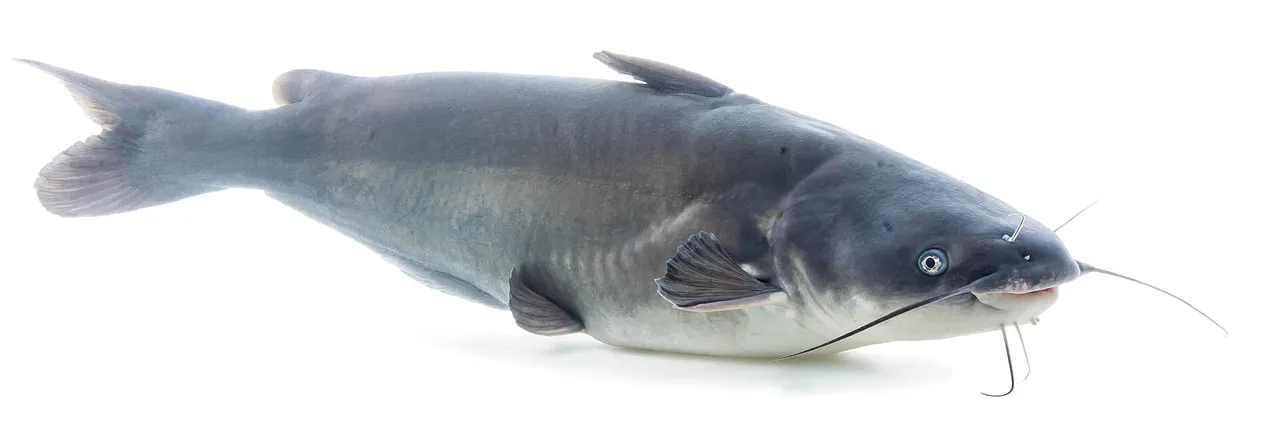
How this was identified, and who took it
Identified by: Identified on the two characters separating blue from channel catfish, both legible: the anal fin is long-based with a STRAIGHT rather than rounded lower margin, and the flank is uniformly unspotted where an adult channel catfish usually retains dark spots. The deeply forked caudal is consistent with both and does no diagnostic work. Photographed on a plain background by a named USFWS photographer at a hatchery, so the subject is a known animal rather than an inferred one.U.S. Fish and Wildlife Service — public domain, via Wikimedia Commons — source, licence_(52880431802).jpg)
Catching Blue catfish
Everything here on fishing for it. Each entry opens the page behind it.
The blue catfish is the largest catfish in North America and the one built for big rivers. It reaches over sixty kilograms, it favours main channels with current and hard bottom rather than the slow backwaters channel catfish tolerate, and it grows considerably larger than either of its common relatives.
It is separated from the channel catfish by the anal fin: blue catfish have a long, straight-edged anal fin with more rays, where channel catfish have a shorter, rounded one with fewer. Colour is unreliable — large channel catfish lose their spots and go grey, which is where most misidentifications come from — and the anal fin is the character that always works.
It is an opportunistic feeder rather than a specialist, taking fish, mussels, crustaceans and carrion, and it is notably effective at exploiting abundant prey. That has become the problem: introduced into Atlantic slope rivers well outside its native range, blue catfish have expanded rapidly and consume large quantities of native fish, blue crabs and shellfish, and are now the subject of active control efforts and management campaigns.
The fishery consequently sits in an unusual position. In the native range it is a highly regarded sport and food fish; in the introduced range, taking fish home is frequently encouraged rather than merely permitted.
How it is caught
- Drift fishingDrifting cut bait across flats and channel edges covers water for a fish that ranges widely in large reservoirs, and it is how the biggest fish are commonly located.
- LedgeringLarge blue catfish feed on the bottom in strong current on cut fish, and a heavy anchored bottom rig is the arrangement that holds a bait in that flow.
Identification
- Scientific name
- Ictalurus furcatus
- Family
- Ictaluridae
- Water
- Freshwater, Brackish
- Conservation status
- Least Concern
- Regions
- North America, Central & South America
- A long, straight-edged anal fin with 30 to 36 rays — the reliable separation from channel catfish, whose anal fin is shorter, rounded and has fewer rays. Count or look at the shape; do not use colour.
- Deeply forked tail, as in channel catfish.
- Uniform blue-grey to slate above with no spots at any size; large channel catfish also lose their spots, which is why the anal fin matters.
- A pronounced hump at the shoulder in large fish.
- Four pairs of barbels; strong serrated spines at the front of the dorsal and pectoral fins.
Size
- Typical
- 2–8 kg (4.4–18 lb)
- Large
- 15–30 kg (33–66 lb)
Exceptional: Over 40 kg (88 lb); maximum published weight 68 kg
Spring spawning in a cavity, guarded by the male
Blue catfish are cavity nesters with male parental care, which is the standard ictalurid pattern.
SPAWNING IS IN LATE SPRING AND EARLY SUMMER, triggered by water temperature rising into a defined band. Timing shifts by weeks with latitude and with the season.
THE NEST IS A SHELTERED CAVITY — an undercut bank, a hollow log, a rock crevice, a submerged object — cleared by the male. Pairs spawn in the cavity and the female departs.
THE MALE GUARDS AND TENDS. He fans the egg mass to oxygenate it, defends the cavity aggressively, and continues to guard the fry for a period after hatching. That investment produces good survival from a comparatively modest egg number, which is the trade-off cavity nesters make.
MATURITY IS LATE FOR A CATFISH and the species is long-lived and grows very large, so the biggest fish represent decades and a substantial share of the reproductive capacity.
RECRUITMENT IS FAIRLY STABLE compared with broadcast spawners, because guarded nests are less exposed to conditions than drifting eggs are.
AND IN INTRODUCED RANGES THIS IS PART OF THE PROBLEM. Where blue catfish have been introduced outside their native basins they reproduce successfully and reach large sizes with few predators, and the resulting populations have become a management concern rather than only a fishery.
Backed by research — why, and the sources (2)
Supported by peer-reviewed research or fisheries science. The sources are listed and can be checked.
- FishBase: a global information system on fishes — Froese, R. and D. Pauly, eds. — FishBase Consortium (Scientific institute)Relied on for: Distribution, habitat association, depth range, size, reproduction and life-history parameters recorded for the species.States this directlyPassage read and verified
- The IUCN Red List of Threatened Species — International Union for Conservation of Nature (Conservation authority)Relied on for: Assessment and range account for the species, including the habitats it depends on, its life history and the pressures acting on it.States this directlyCitation checked — the work exists and is described correctly
A cold-water feeder that reverses the usual catfish calendar
Blue catfish have a seasonal pattern that surprises anglers who expect catfish to be a summer fish.
THEY FEED WELL IN COLD WATER. Unlike most catfish, blue catfish remain active and feed hard through winter, and in many large river and reservoir fisheries the cold months produce the largest fish. Winter is a peak rather than a trough.
SUMMER PUSHES THEM DEEP. In warm months fish move to deeper channels and thermally comfortable water, and in stratified reservoirs they occupy the layer between warm surface water and deoxygenated depths.
SPRING IS THE SPAWNING PERIOD, with fish moving to shallow cavity habitat and the fishery changing accordingly.
THEY FOLLOW BAIT SEASONALLY, and in reservoirs holding shad the winter concentration of blue catfish frequently coincides with shad die-offs and with the deep congregations of prey that cold water produces.
CURRENT AND FLOW EVENTS MOVE THEM in rivers, with rises bringing fish onto flats and into the flow to feed on displaced food.
AND THE PRACTICAL POINT IS THAT THE SPECIES INVERTS THE USUAL ADVICE. An angler applying warm-water catfish assumptions to blue catfish in January will miss the best fishing of the year.
Backed by research — why, and the sources (2)
Supported by peer-reviewed research or fisheries science. The sources are listed and can be checked.
- FishBase: a global information system on fishes — Froese, R. and D. Pauly, eds. — FishBase Consortium (Scientific institute)Relied on for: Distribution, habitat association, depth range, size, reproduction and life-history parameters recorded for the species.States this directlyPassage read and verified
- The IUCN Red List of Threatened Species — International Union for Conservation of Nature (Conservation authority)Relied on for: Assessment and range account for the species, including the habitats it depends on, its life history and the pressures acting on it.States this directlyCitation checked — the work exists and is described correctly
The same spines, and a size that changes what safe handling means
Blue catfish reach a size at which the handling question is no longer about the spines at all, and the transition catches people out because the fish looks like a larger version of something they already know how to hold.
THE SPINES ARE ORDINARY ICTALURID SPINES — dorsal and two pectoral, locking, venom-associated at the base, producing deep narrow punctures that infect readily. The grip that avoids them on a small fish is from behind, palm to belly, pectorals between the fingers.
AT LARGE SIZE THAT GRIP IS IRRELEVANT because one person cannot hold the fish that way. A very large blue catfish must be supported horizontally with both hands and preferably by two people, or lipped by the lower jaw with the body supported. Blue catfish have no cutting teeth; the jaw pads rasp and do not slice.
AND THE MASS IS THE INJURY TO THE FISH. Holding a fish of this size vertically, or by the gill cover, or letting it hang from a grip while somebody adjusts a camera, causes internal damage that is invisible and frequently fatal. The species is long-lived and large individuals are old; a trophy blue catfish is not replaceable on any useful timescale.
THE WATER TEMPERATURE DECIDES THE MARGIN. In warm summer water a large blue catfish that has fought hard has very little tolerance for air exposure. Keep it in the water, in the net, while everything else is prepared, and lift it for seconds.
AND THE BIOSECURITY POINT IS NOT INCIDENTAL. This species is introduced well outside its native range and is a management problem in several systems. Moving live fish between waters is how that happened. Do not do it, and where local rules require introduced catfish to be killed rather than returned, that instruction overrides everything above.
Official guidance — why, and the sources (1)
Stated by a fisheries authority, scientific institute or recognised angling body. Authoritative, but summarising rather than demonstrating.
- Check Clean Dry — biosecurity guidance for water users — GB Non-native Species Secretariat (Conservation authority)Relied on for: General principle that moving live fish between waters is a primary vector for the spread of non-native species, and that local rules may require introduced fish not to be returned.Background and mechanism onlyPassage read and verified
Lifecycle and reproduction
Grows large and lives long, with maturity at four to seven years and lifespans well over twenty. Spawns in early summer in cavities, with the male guarding the eggs, in the same broad pattern as other North American catfish. Favours large river main channels with current, and moves considerable distances seasonally, including into brackish estuarine water.
Cavity nesting in early summer, with the male preparing the site and guarding and aerating the eggs until hatching. Tolerance of brackish water lets the species use estuarine reaches unavailable to most freshwater catfish, which is one of the factors behind its rapid expansion in the Atlantic slope rivers where it was introduced.
Feeding and senses
An opportunistic feeder taking fish, mussels, crustaceans and carrion, and unusually effective at exploiting whatever is locally abundant. In introduced ranges this has meant heavy consumption of native fish, blue crabs and shellfish. Feeding is driven by chemical detection, as in all catfish, which is why cut bait and fresh dead fish are the standard approach.
Chemoreception dominates, with external taste receptors over the body and concentrated on the barbels, allowing the fish to locate food in turbid main-channel water where sight is useless. Hearing is acute. This sensory profile explains both the effectiveness of scent baits and the species' success in the murky large rivers it prefers.
Through the year
Moves seasonally within large river systems, often considerable distances, following temperature and prey, and using deeper channels in winter and shallower feeding areas in the warmer months. In the introduced Atlantic slope range it moves into brackish estuarine water, which extends both its habitat and its impact.
Distribution
North America: native to the Mississippi, Missouri and Ohio River basins and Gulf drainages south into Mexico. Introduced into Atlantic slope rivers and elsewhere, where it has expanded rapidly and is the subject of active control efforts.
This is a biological range — where the species occurs, not a prediction that you will catch one. To browse the fishing geography FishingHQ holds, start at fishing places.
Why anglers care
A major sport and food fishery in the native range, taken on cut bait and fresh dead fish fished on the bottom from banks and boats, and capable of producing very large fish. In the introduced range the fishery is frequently promoted as a control measure, which means the usual assumption that a fish should be returned does not apply — and that is a local question with a local answer.
Handling and returning
Serrated dorsal and pectoral spines on a very large powerful fish. Hold from beneath with the hand behind the pectoral spines, never around the front of the body, and use two people for a large fish. Wet hands, support horizontally, and clean any puncture properly — catfish spine wounds infect readily and seriously.
Going further
- What does blue catfish eat? — feeding biology, kept separate from what anglers infer from it.
- Blue catfish vs Flathead catfish — how to tell them apart.
- Blue catfish vs Channel catfish — how to tell them apart.
Safety
Venomous and spined species — Can cause serious injury or death
Strong serrated dorsal and pectoral spines on a fish that can exceed sixty kilograms, driving deep punctures that infect readily.
What reduces it: Hold from beneath with the hand behind the pectoral spines. Never grip around the front of the body. Two people for a large fish. Clean any puncture immediately and properly.
Biosecurity and disease transfer — Can cause serious injury or death
Blue catfish introduced outside their native range have expanded rapidly and consume large quantities of native fish, crabs and shellfish. Live movement is the route.
What reduces it: Never move live fish or water between waters. Where the species is non-native, establish the local requirement rather than assuming a fish should be returned — in several jurisdictions returning one is actively discouraged.
Precautions that always apply here
- Handle spined and venomous species with the spines controlled. Know which local species have them before you fish, not afterwards.
- Wet your hands before touching a fish. Dry hands strip the protective mucus layer that keeps infection out.
- Check, clean and dry your kit between different waters — the published guidance is 48 hours’ drying, in sunlight where possible, because a number of invasive species survive over two weeks in damp conditions. Nets, boots and wet mats move invasive species and disease more effectively than anything else anglers do.
- Never move live fish, live bait or water from one water to another.
Check the rules before you fish
Fishing laws, bylaws, access rules, seasons, bait restrictions and permitted methods vary by location and can change. Check the current rules from the relevant authority and the water you intend to fish before fishing.
Check with:
- Current national or regional law for where you are fishing
- Current local bylaws
- The relevant fisheries authority
- The landowner, club or fishery whose water it is
- Any restrictions specific to the species or the method you intend to use
Where to go next
Similar and related fish
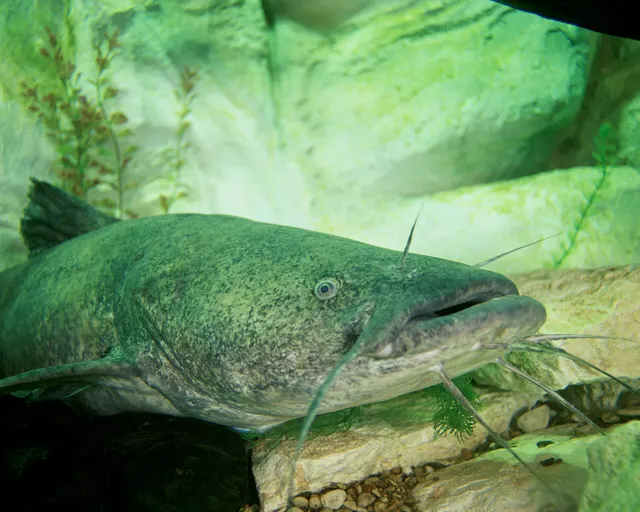 Flathead catfishBoth are large North American catfish and both are serious invasives where introduced, but they feed differently: blue catfish scavenge opportunistically, flatheads take live fish only.
- Gizzard shadGizzard shad are the dominant prey of blue catfish in the reservoir systems where both occur, and winter shad die-offs are a substantial feeding event for them.
Told apart from
More fish
Not related to this page — just the rest of the section. There is little else joined to this subject yet, and a short page should still lead somewhere.
Sources and evidence
- FishBase: a global information system on fishes — Froese, R. and D. Pauly, eds. — FishBase Consortium (Scientific institute)Relied on for: Scientific name, family placement in the Ictaluridae, a maximum length of 165 cm TL, a maximum published weight of 68.0 kg, a maximum reported age of 21 years.States this directlyPassage read and verified
- FishBase: a global information system on fishes — Froese, R. and D. Pauly, eds. — FishBase Consortium (Scientific institute)Relied on for: Environment, climate zone and depth range as recorded: Freshwater; brackish; demersal; potamodromous ; depth range ? - 50 m . Subtropical; 44°N - 15°N, 108°W - 80°WStates this directlyPassage read and verified
- FishBase: a global information system on fishes — Froese, R. and D. Pauly, eds. — FishBase Consortium (Scientific institute)Relied on for: The IUCN Red List category for Ictalurus furcatus — Least Concern, assessed 20 February 2012 — as republished by FishBase, the Red List itself being unreachable during review.States this directlyPassage read and verified
- Check Clean Dry — biosecurity guidance for water users — GB Non-native Species Secretariat (Conservation authority)Relied on for: The framework by which introduced predatory fish are assessed and managed, and live movement as the transmission route.FishingHQ's interpretation of what it saysPassage read and verified
Why the 5 connections on this page are here, and the sources
Similar and related fish
Backed by research — 2 connections
Supported by peer-reviewed research or fisheries science. The sources are listed and can be checked.
Flathead catfish
A comparison resting on documented dietary difference, naming both binomials.
- FishBase: a global information system on fishes — Froese, R. and D. Pauly, eds. — FishBase Consortium (Scientific institute)Relied on for: That Ictalurus furcatus and Pylodictis olivaris are both Ictaluridae of large North American rivers with differing feeding ecology.States this directlyPassage read and verified
Gizzard shad
Recorded diet evidence identifies Dorosoma cepedianum as a food item of this predator at species level. The edge is written at that granularity and no further.
- FishBase: a global information system on fishes — Froese, R. and D. Pauly, eds. — FishBase Consortium (Scientific institute)Relied on for: Food items recorded for this predator, including Dorosoma cepedianum.States this directlyPassage read and verified
- FAO Species Identification Guides for Fishery Purposes and the FAO Species Catalogues — Food and Agriculture Organization of the United Nations (Scientific institute)Relied on for: Species account describing the diet of this predator in the region where Dorosoma cepedianum occurs.Background and mechanism onlyCitation checked — the work exists and is described correctly
How it is caught
What experienced anglers do — 2 connections
Widely and independently recommended by experienced anglers and specialist sources. This is real angling knowledge, not proof: controlled evidence for it is limited, and FishingHQ records it as convention rather than as a demonstrated effect.
Drift fishing
Established angling practice for this species, recorded as convention. The note states the property of the animal or its water that makes the method the answer.
- IGFA International Angling Rules and World Record Requirements — International Game Fish Association (Angling or fisheries organisation)Relied on for: Recognition of the species as an established sport fish and the angling methods and tackle classes conventionally used for it.States this directlyPassage read and verified
- General angling website restatements of established technique — Various (Credible secondary source)Relied on for: Widely restated practice connecting this species and method.Background and mechanism onlyCitation checked — the work exists and is described correctly
Ledgering
Established angling practice for this species, recorded as convention. The note states the property of the animal or its water that makes the method the answer.
- IGFA International Angling Rules and World Record Requirements — International Game Fish Association (Angling or fisheries organisation)Relied on for: Recognition of the species as an established sport fish and the angling methods and tackle classes conventionally used for it.States this directlyPassage read and verified
- General angling website restatements of established technique — Various (Credible secondary source)Relied on for: Widely restated practice connecting this species and method.Background and mechanism onlyCitation checked — the work exists and is described correctly
Told apart from
Backed by research — 1 connection
Supported by peer-reviewed research or fisheries science. The sources are listed and can be checked.
Channel catfish
An identification comparison naming both binomials, addressing the commonest misidentification in North American catfishing.
- FishBase: a global information system on fishes — Froese, R. and D. Pauly, eds. — FishBase Consortium (Scientific institute)Relied on for: That Ictalurus punctatus and Ictalurus furcatus are congeners in the genus Ictalurus occupying overlapping Mississippi and Gulf drainage ranges.States this directlyPassage read and verified
An identification link between two species readers genuinely mistake for one another, resting on published morphological characters rather than on angling lore, and naming the character that separates them.
- FishBase: a global information system on fishes — Froese, R. and D. Pauly, eds. — FishBase Consortium (Scientific institute)Relied on for: Morphological description, meristic counts, family placement, distribution and environment of the species named.States this directlyPassage read and verified
- FAO Species Identification Guides for Fishery Purposes and the FAO Species Catalogues — Food and Agriculture Organization of the United Nations (Scientific institute)Relied on for: Identification characters and distribution for inland and coastal fishes, from regional identification guides prepared for fishery purposes.States this directlyCitation checked — the work exists and is described correctly
How FishingHQ labels evidence is explained in the evidence policy.