How to identify blue catfish
Ictalurus furcatus · Ictaluridae
The characters that identify blue catfish, ranked by how far each one can be trusted on its own.
Safety: venomous and spined species — can cause serious injury or death. One more point applies here.
How this was identified, and who took it
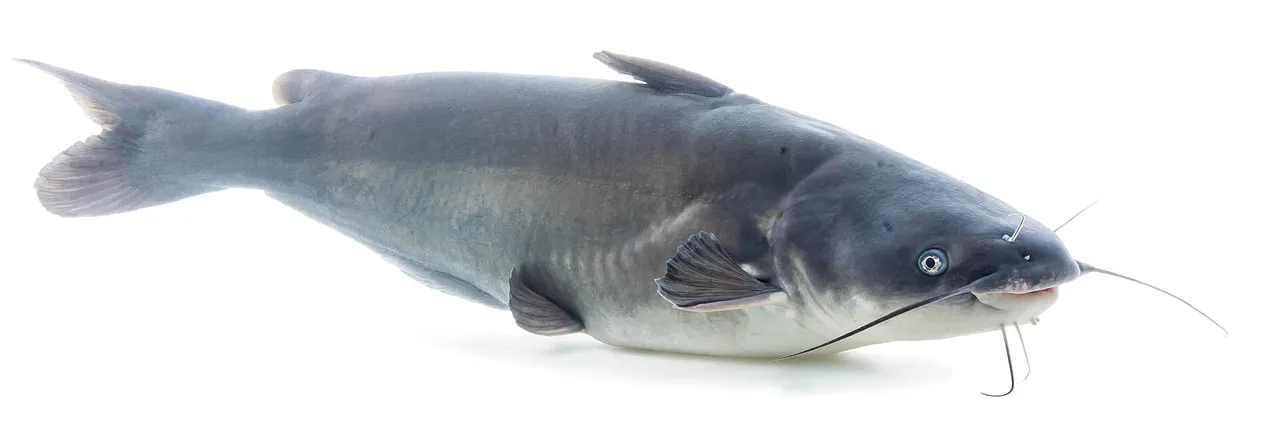
Identified by: Identified on the two characters separating blue from channel catfish, both legible: the anal fin is long-based with a STRAIGHT rather than rounded lower margin, and the flank is uniformly unspotted where an adult channel catfish usually retains dark spots. The deeply forked caudal is consistent with both and does no diagnostic work. Photographed on a plain background by a named USFWS photographer at a hatchery, so the subject is a known animal rather than an inferred one.U.S. Fish and Wildlife Service — public domain, via Wikimedia Commons — source, licenceLook at this first
Look at the anal fin — the one on the underside, behind the vent — and read its lower edge. On a blue catfish it is long and the margin runs STRAIGHT, like the edge of a ruler. On a channel catfish the same fin is shorter and curves. That one line settles the pair at any size.
Diagnostic — settles it on its own
Each of these settles the identification on its own. If one is clear, you have your answer.
The straight margin of the anal fin
The anal fin is long-based with a straight or very slightly sloping lower edge, carrying roughly thirty or more rays. A channel catfish's anal fin is shorter and its margin is distinctly rounded. This is a bone-and-ray relationship rather than a marking, so it does not change with water, season or condition, and it survives on a dead fish.
Supporting — use with other characters
Real characters that are not conclusive by themselves. Use two or three together.
No spots on the flank
An adult blue catfish is plain: uniform blue-grey to slate above, white below, with no dark spotting. Channel catfish usually retain scattered dark spots into adulthood, though large old channel cats can lose them — which is exactly why this character supports the anal fin rather than replacing it.
The straight-edged, high-shouldered profile
Blue catfish have a noticeably straight-sloping back rising to a humped shoulder in front of the dorsal, giving a heavier, more angular outline than the smoother curve of a channel catfish. A proportion rather than a measurement, and best judged on a fish in profile.
Suggestive only — varies with condition
Hints only. These vary with condition, season, water and how long the fish has been out of it, and a fish that contradicts them is still the same species.
Colour
The blue in the name is unreliable. Fish from clear water can look genuinely blue-grey; the same species from turbid river water is a flat brown-grey with no blue in it at all. Never separate the two species on colour, and be especially wary of it in a photograph, where white balance decides the answer.
What it gets confused with
- Channel catfish, everywhere the two share water. Anal fin margin first, spotting second, and nothing else.
- Flathead catfish, which is separated instantly by its squared-off tail and protruding lower jaw and is not really a confusion once seen.
- Hybrids of blue and channel catfish, produced in aquaculture and present in some waters, which are intermediate in the anal fin and cannot be resolved by this page.
Side by side: Blue catfish vs Flathead catfish, Blue catfish vs Channel catfish.
Where this stops working
The anal fin character is reliable and it needs the fin spread to be read. On a fish lying on its side in a boat with the fin folded, it is not visible at all, and a great many misidentifications happen for that reason rather than through any subtlety. Ray counts are the underlying character and counting them on a live fish is impractical, so the page uses the shape of the margin as its proxy. Aquaculture hybrids are the genuine limit: where they occur, the margin is intermediate and no field character available to an angler will settle it.
The full record
This page covers identification only. The Blue catfish record covers behaviour, lifecycle, distribution, handling and the sources behind all of it.
Reviewed 2026-08-13.
More about this fish
Telling it apart is one question. Here are the others.
Similar and related fish
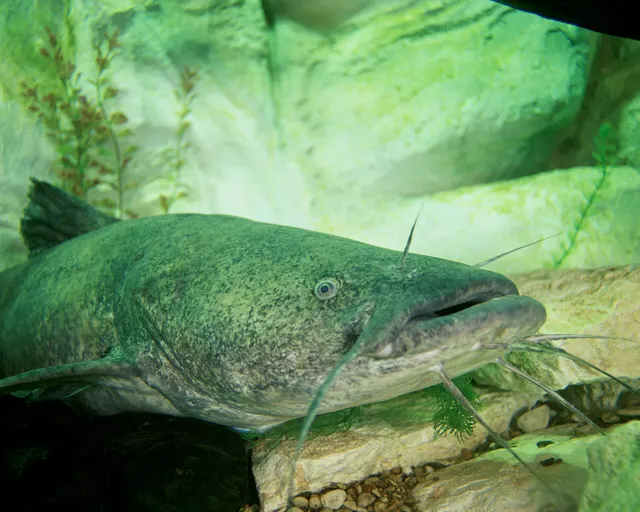 Flathead catfishBoth are large North American catfish and both are serious invasives where introduced, but they feed differently: blue catfish scavenge opportunistically, flatheads take live fish only.
- Gizzard shadGizzard shad are the dominant prey of blue catfish in the reservoir systems where both occur, and winter shad die-offs are a substantial feeding event for them.
How it is caught
- Drift fishingDrifting cut bait across flats and channel edges covers water for a fish that ranges widely in large reservoirs, and it is how the biggest fish are commonly located.
- LedgeringLarge blue catfish feed on the bottom in strong current on cut fish, and a heavy anchored bottom rig is the arrangement that holds a bait in that flow.
Why the 4 connections on this page are here, and the sources
Similar and related fish
Backed by research — 2 connections
Supported by peer-reviewed research or fisheries science. The sources are listed and can be checked.
Flathead catfish
A comparison resting on documented dietary difference, naming both binomials.
- FishBase: a global information system on fishes — Froese, R. and D. Pauly, eds. — FishBase Consortium (Scientific institute)Relied on for: That Ictalurus furcatus and Pylodictis olivaris are both Ictaluridae of large North American rivers with differing feeding ecology.States this directlyPassage read and verified
Gizzard shad
Recorded diet evidence identifies Dorosoma cepedianum as a food item of this predator at species level. The edge is written at that granularity and no further.
- FishBase: a global information system on fishes — Froese, R. and D. Pauly, eds. — FishBase Consortium (Scientific institute)Relied on for: Food items recorded for this predator, including Dorosoma cepedianum.States this directlyPassage read and verified
- FAO Species Identification Guides for Fishery Purposes and the FAO Species Catalogues — Food and Agriculture Organization of the United Nations (Scientific institute)Relied on for: Species account describing the diet of this predator in the region where Dorosoma cepedianum occurs.Background and mechanism onlyCitation checked — the work exists and is described correctly
How it is caught
What experienced anglers do — 2 connections
Widely and independently recommended by experienced anglers and specialist sources. This is real angling knowledge, not proof: controlled evidence for it is limited, and FishingHQ records it as convention rather than as a demonstrated effect.
Drift fishing
Established angling practice for this species, recorded as convention. The note states the property of the animal or its water that makes the method the answer.
- IGFA International Angling Rules and World Record Requirements — International Game Fish Association (Angling or fisheries organisation)Relied on for: Recognition of the species as an established sport fish and the angling methods and tackle classes conventionally used for it.States this directlyPassage read and verified
- General angling website restatements of established technique — Various (Credible secondary source)Relied on for: Widely restated practice connecting this species and method.Background and mechanism onlyCitation checked — the work exists and is described correctly
Ledgering
Established angling practice for this species, recorded as convention. The note states the property of the animal or its water that makes the method the answer.
- IGFA International Angling Rules and World Record Requirements — International Game Fish Association (Angling or fisheries organisation)Relied on for: Recognition of the species as an established sport fish and the angling methods and tackle classes conventionally used for it.States this directlyPassage read and verified
- General angling website restatements of established technique — Various (Credible secondary source)Relied on for: Widely restated practice connecting this species and method.Background and mechanism onlyCitation checked — the work exists and is described correctly
Safety
Venomous and spined species — Can cause serious injury or death
Strong serrated dorsal and pectoral spines on a fish that can exceed sixty kilograms, driving deep punctures that infect readily.
What reduces it: Hold from beneath with the hand behind the pectoral spines. Never grip around the front of the body. Two people for a large fish. Clean any puncture immediately and properly.
Biosecurity and disease transfer — Can cause serious injury or death
Blue catfish introduced outside their native range have expanded rapidly and consume large quantities of native fish, crabs and shellfish. Live movement is the route.
What reduces it: Never move live fish or water between waters. Where the species is non-native, establish the local requirement rather than assuming a fish should be returned — in several jurisdictions returning one is actively discouraged.