Flathead catfish
Fish · Last reviewed 2026-08-10
A large, solitary, strictly predatory catfish that eats live fish and almost nothing else — which makes it the one catfish that will not take a stink bait.
Safety: venomous and spined species — can cause serious injury or death. 5 more points apply here.
How this was identified, and who took it
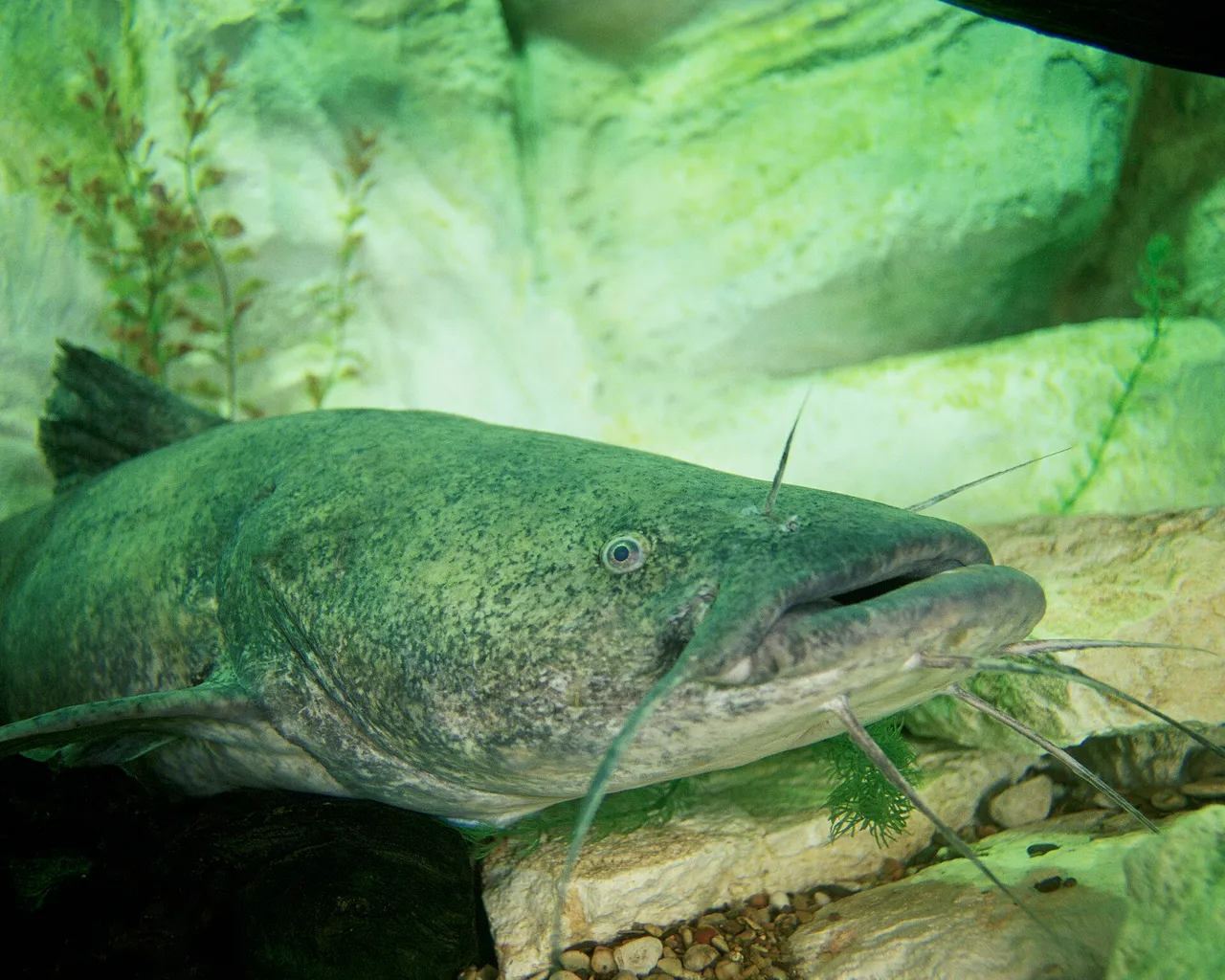
Identified by: The projecting lower jaw — the character that separates this species from channel and blue catfish at a glance — is unmistakable, along with the flattened head, small eyes and mottled olive flank. A head-and-shoulders view; the caudal fin is outside the frame.Engbretson, Eric / U.S. Fish and Wildlife Service — Public domain, via Wikimedia Commons — source, licence
Catching Flathead catfish
Everything here on fishing for it. Each entry opens the page behind it.
The flathead catfish is the exception that proves the rule about catfish. Where channel and blue catfish are omnivorous scavengers that respond to scent, the flathead is a specialist predator that eats live fish, and it is famously indifferent to the prepared and cut baits that work for its relatives.
That single dietary fact reorganises everything. Flathead fishing is live-bait fishing, usually with a substantial live fish, presented near heavy cover where an adult flathead spends the day. The fish are solitary and territorial, they occupy specific lairs — log jams, undercut banks, rock ledges — and they emerge at night to hunt. An angler who understands that is fishing a known lair with a live bait after dark; an angler who does not is fishing a stink bait in open water and catching channel catfish.
It is easily separated from other North American catfish by the squared rather than forked tail, the strongly flattened head, and the lower jaw projecting beyond the upper — the reverse of channel catfish.
It has been introduced well outside its native range within North America, where it is a serious predatory invasive that has substantially reduced native fish populations in several river systems. That is a genuine and well-documented problem rather than a theoretical one.
Identification
- Scientific name
- Pylodictis olivaris
- Family
- Ictaluridae
- Water
- Freshwater
- Conservation status
- Least Concern
- Regions
- North America
- Tail squared or only very slightly notched — never deeply forked, which separates it immediately from channel and blue catfish.
- Head strongly flattened from above, and the LOWER jaw projects beyond the upper — the reverse of channel catfish.
- Mottled yellow-brown to olive colouring, giving the local name yellow cat; the pattern is irregular rather than spotted.
- Small eyes set high on a broad flat head.
- Strong serrated spines at the front of the dorsal and pectoral fins, as in all North American catfish.
Size
- Typical
- 2–7 kg (4–15 lb)
- Large
- 15–25 kg (33–55 lb)
Exceptional: Over 35 kg (77 lb); maximum published weight 55.8 kg
A cavity nest, a guarding male, and a predator from the start
Flathead catfish spawn in cavities with male care, and their juveniles behave unlike other catfish almost immediately.
SPAWNING IS IN LATE SPRING AND SUMMER when water reaches a threshold temperature, later than most catfish in the same rivers.
THE NEST IS A SHELTERED CAVITY — a hollow log, an undercut bank, a crevice among rock or debris — which the male clears and then guards. Pairs spawn in the cavity, the female leaves, and the male tends the compact egg mass, fanning it constantly.
HE GUARDS AFTER HATCHING TOO, keeping the fry in a tight ball in the nest for a period, which is an unusually extended investment.
JUVENILES TURN PISCIVOROUS EARLY. Unlike channel or blue catfish, which are generalist scavengers for much of their lives, flathead catfish shift to eating live fish while still small, and adults are almost exclusively piscivorous and prefer live prey. That has consequences well beyond the fish itself.
WHICH IS WHY THE INTRODUCED POPULATIONS ARE A PROBLEM. Where flathead catfish have been introduced outside their native basins they have reduced native fish populations substantially, and they are managed as an invasive predator in several river systems rather than only as a fishery.
MATURITY IS AT SEVERAL YEARS, growth is fast in warm productive water, and the species is long-lived and reaches very large sizes.
Backed by research — why, and the sources (2)
Supported by peer-reviewed research or fisheries science. The sources are listed and can be checked.
- FishBase: a global information system on fishes — Froese, R. and D. Pauly, eds. — FishBase Consortium (Scientific institute)Relied on for: Distribution, habitat association, depth range, size, reproduction and life-history parameters recorded for the species.States this directlyPassage read and verified
- The IUCN Red List of Threatened Species — International Union for Conservation of Nature (Conservation authority)Relied on for: Assessment and range account for the species, including the habitats it depends on, its life history and the pressures acting on it.States this directlyCitation checked — the work exists and is described correctly
A warm-season predator that shuts down in the cold
Flathead catfish are strongly seasonal and their pattern is the opposite of the blue catfish that frequently share their rivers.
THEY FEED HARD IN WARM WATER AND BARELY AT ALL IN COLD. Activity rises sharply as water warms through spring, peaks through summer, and falls away in autumn. In winter flathead catfish become largely inactive, holding in deep cover and feeding minimally — which is why winter catfish fisheries target blues rather than flatheads.
SUMMER NIGHTS ARE THE PEAK. Flatheads are strongly nocturnal as adults, moving from daytime cover into shallower feeding areas after dark and returning before light. That daily movement is more pronounced in summer than at any other time.
THEY OCCUPY DEEP COVER BY DAY — log jams, undercut banks, rock and deep holes — and the same fish uses the same daytime cover repeatedly.
SPAWNING IN EARLY SUMMER interrupts the feeding pattern, with males occupying and guarding cavities.
FLOW EVENTS MOVE THEM. Rises in river systems shift fish and bring them onto feeding ground, and falling water concentrates them back into holes.
AND THE LIVE-PREY PREFERENCE IS A SEASONAL PRACTICALITY as much as a biological fact: it is why flathead fishing is a live-bait fishery in a way blue and channel catfish fishing is not, and why the season effectively follows the availability of the prey species they hunt.
Backed by research — why, and the sources (2)
Supported by peer-reviewed research or fisheries science. The sources are listed and can be checked.
- FishBase: a global information system on fishes — Froese, R. and D. Pauly, eds. — FishBase Consortium (Scientific institute)Relied on for: Distribution, habitat association, depth range, size, reproduction and life-history parameters recorded for the species.States this directlyPassage read and verified
- The IUCN Red List of Threatened Species — International Union for Conservation of Nature (Conservation authority)Relied on for: Assessment and range account for the species, including the habitats it depends on, its life history and the pressures acting on it.States this directlyCitation checked — the work exists and is described correctly
Locking spines on a very large fish, and the grip that keeps hands out of the way
The channel catfish account explains why ictalurid spines injure people: dorsal and pectoral spines lock rigid, so a hand closing on the fish drives them in. Flathead catfish present the same mechanism at a size where the forces are much greater.
WHAT CHANGES WITH SIZE. On a small catfish the spine is driven in by the angler's own grip. On a fifty-pound flathead the spine is driven in by the fish, and the wound is correspondingly deep. The venom associated with ictalurid spines produces disproportionate pain and the puncture is narrow, deep and hard to clean — the combination behind the high infection rate that makes catfish spine injuries a recognised presentation in emergency medicine.
THE GRIP IS DIFFERENT ON A LARGE FISH. The small-catfish grip from behind, palm under the belly with the pectorals between the fingers, does not scale. A large flathead is handled by supporting it horizontally with a hand under the belly forward of the pelvic fins and one supporting the tail region, or by lip-gripping the lower jaw — flatheads have no cutting teeth, only rasping pads, and lipping is genuinely safe on this species in a way it is not on most large predators. The pads will abrade skin over a long hold; they will not cut.
KEEP THE SPINES ORIENTED AWAY. The pectoral spines project laterally, which means they are pointing at whoever is standing beside the fish. On a boat that is usually somebody else.
AND THE FISH'S SIDE IS THE MASS. A large flathead held vertically by the jaw is unsupported, and the damage is internal. Horizontal support, wet hands, and back in the water quickly — these are warm-water fish often caught in high summer temperatures, when their tolerance for air exposure is at its lowest.
What experienced anglers do — why, and the sources (2)
Widely and independently recommended by experienced anglers and specialist sources. This is real angling knowledge, not proof: controlled evidence for it is limited, and FishingHQ records it as convention rather than as a demonstrated effect.
- FishBase: a global information system on fishes — Froese, R. and D. Pauly, eds. — FishBase Consortium (Scientific institute)Relied on for: Dentition, fin and spine morphology, body form, air-breathing capability and distribution for the species, which are the anatomical facts the handling practice below follows from.States this directlyPassage read and verified
- General angling website restatements of established technique — Various (Credible secondary source)Relied on for: Widely restated angling practice for handling this species, recorded as practitioner consensus rather than as tested fact.Background and mechanism onlyCitation checked — the work exists and is described correctly
Lifecycle and reproduction
Grows large and lives long, with maturity at four to six years and a lifespan of over twenty. Spawns in early summer in cavities, with the male guarding the eggs. Adults are solitary and territorial, occupying specific structures for extended periods, which makes individual fish locatable and also makes a good lair worth returning to — and worth not stripping.
Cavity nesting in early summer, with the male preparing the site, guarding the eggs and fanning them, in the same broad pattern as channel catfish. The territoriality of adults means suitable cavity habitat is contested, and a river with limited large woody debris supports fewer adults than its water quality alone would suggest.
Feeding and senses
Almost exclusively piscivorous as an adult, taking live fish and crayfish, and notably uninterested in dead or prepared baits — which is the practical fact that defines the fishery. Young fish take invertebrates. Adults hunt at night, leaving daytime lairs to feed in shallower water, and return before daylight.
Like other catfish, chemically and acoustically acute rather than visual, with the barbels and lateral line locating prey in darkness and turbidity. The difference from channel catfish is not sensory but behavioural: the flathead uses the same equipment to detect a live moving fish rather than a scent trail from something dead.
Through the year
Feeding rises sharply with water temperature and is strongest through the warm months, with fish holding in deep holes and becoming largely inactive in cold water. Summer nights are the productive period; daylight fishing means fishing the lair rather than the feeding ground. Northern-hemisphere calendar throughout the native range.
Distribution
North America: native to the Mississippi, Missouri and Ohio River basins and Gulf drainages from Texas to Mexico. Introduced well outside that range within North America, including into Atlantic slope rivers, where it is established and is a documented predatory pressure on native fish.
This is a biological range — where the species occurs, not a prediction that you will catch one. To browse the fishing geography FishingHQ holds, start at fishing places.
Why anglers care
A specialist fishery built around live bait presented near cover at night, with a dedicated following. Highly regarded as a table fish. Where the species is introduced, angling is in places actively encouraged as a control measure, which is an unusual position for a large sport fish and worth understanding before assuming a fish should be returned.
Handling and returning
Serrated dorsal and pectoral spines on a large, powerful fish. Support the body from beneath with the hand behind the pectoral spines, or use a lip grip; never grip around the front of the body. Wet hands, support a large fish horizontally with two hands, and clean any puncture properly. Where the species is introduced, whether a fish should be returned is a local question with a local answer.
Going further
- What does flathead catfish eat? — feeding biology, kept separate from what anglers infer from it.
- Flathead catfish vs Blue catfish — how to tell them apart.
Safety
Venomous and spined species — Can cause serious injury or death
Strong serrated dorsal and pectoral spines on a large powerful fish, driving deep punctures that infect readily.
What reduces it: Hold from beneath with the hand behind the pectoral spines, or use a lip grip. Never grip around the front of the body. Two people for a large fish. Clean any puncture immediately and properly.
Biosecurity and disease transfer — Can cause serious injury or death
Flathead catfish introduced outside their native range are effective predators that have substantially reduced native fish populations in several North American river systems.
What reduces it: Never move live fish or water between waters. Where the species is non-native, establish the local requirement rather than assuming a fish should be returned — in several jurisdictions returning one is not the responsible act it would normally be.
Precautions that always apply here
- Handle spined and venomous species with the spines controlled. Know which local species have them before you fish, not afterwards.
- Wet your hands before touching a fish. Dry hands strip the protective mucus layer that keeps infection out.
- Check, clean and dry your kit between different waters — the published guidance is 48 hours’ drying, in sunlight where possible, because a number of invasive species survive over two weeks in damp conditions. Nets, boots and wet mats move invasive species and disease more effectively than anything else anglers do.
- Never move live fish, live bait or water from one water to another.
Check the rules before you fish
Fishing laws, bylaws, access rules, seasons, bait restrictions and permitted methods vary by location and can change. Check the current rules from the relevant authority and the water you intend to fish before fishing.
Check with:
- Current national or regional law for where you are fishing
- Current local bylaws
- The relevant fisheries authority
- The landowner, club or fishery whose water it is
- Any restrictions specific to the species or the method you intend to use
Where to go next
Similar and related fish
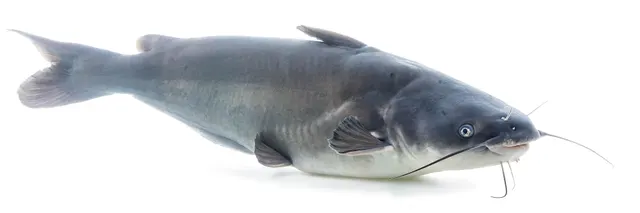 Blue catfishBoth are large North American catfish and both are serious invasives where introduced, but they feed differently: blue catfish scavenge opportunistically, flatheads take live fish only.
- Gizzard shadFlathead catfish take live fish almost exclusively as adults, and gizzard shad are a principal item where they are abundant.
Told apart from
More fish
Not related to this page — just the rest of the section. There is little else joined to this subject yet, and a short page should still lead somewhere.
Sources and evidence
- FishBase: a global information system on fishes — Froese, R. and D. Pauly, eds. — FishBase Consortium (Scientific institute)Relied on for: Scientific name, family placement in the Ictaluridae, a maximum length of 155 cm TL, a maximum published weight of 55.8 kg, a maximum reported age of 25 years.States this directlyPassage read and verified
- FishBase: a global information system on fishes — Froese, R. and D. Pauly, eds. — FishBase Consortium (Scientific institute)Relied on for: Environment, climate zone and depth range as recorded: Freshwater; demersal; potamodromous . Subtropical; ? - 33°C ; 47°N - 26°N, 108°W - 80°WStates this directlyPassage read and verified
- FishBase: a global information system on fishes — Froese, R. and D. Pauly, eds. — FishBase Consortium (Scientific institute)Relied on for: The IUCN Red List category for Pylodictis olivaris — Least Concern, assessed 01 March 2012 — as republished by FishBase, the Red List itself being unreachable during review.States this directlyPassage read and verified
- Check Clean Dry — biosecurity guidance for water users — GB Non-native Species Secretariat (Conservation authority)Relied on for: The framework by which introduced predatory fish are assessed and managed, and live movement as the transmission route.States this directlyPassage read and verified
Why the 4 connections on this page are here, and the sources
Similar and related fish
Backed by research — 2 connections
Supported by peer-reviewed research or fisheries science. The sources are listed and can be checked.
Blue catfish
A comparison resting on documented dietary difference, naming both binomials.
- FishBase: a global information system on fishes — Froese, R. and D. Pauly, eds. — FishBase Consortium (Scientific institute)Relied on for: That Ictalurus furcatus and Pylodictis olivaris are both Ictaluridae of large North American rivers with differing feeding ecology.States this directlyPassage read and verified
Gizzard shad
Recorded diet evidence identifies Dorosoma cepedianum as a food item of this predator at species level. The edge is written at that granularity and no further.
- FishBase: a global information system on fishes — Froese, R. and D. Pauly, eds. — FishBase Consortium (Scientific institute)Relied on for: Food items recorded for this predator, including Dorosoma cepedianum.States this directlyPassage read and verified
- FAO Species Identification Guides for Fishery Purposes and the FAO Species Catalogues — Food and Agriculture Organization of the United Nations (Scientific institute)Relied on for: Species account describing the diet of this predator in the region where Dorosoma cepedianum occurs.Background and mechanism onlyCitation checked — the work exists and is described correctly
How it is caught
What experienced anglers do — 1 connection
Widely and independently recommended by experienced anglers and specialist sources. This is real angling knowledge, not proof: controlled evidence for it is limited, and FishingHQ records it as convention rather than as a demonstrated effect.
Livebaiting
A practitioner claim following directly from the species' verified diet.
- General angling website restatements of established technique — Various (Credible secondary source)Relied on for: Widely restated practitioner accounts that flathead catfish take live bait and refuse cut and prepared baits.Citation checked — the work exists and is described correctly
- Angling Times — Bauer Media (Specialist angling publication)Relied on for: Contemporary treatment of live bait presentation for large predatory fish.Citation checked — the work exists and is described correctly
Told apart from
Backed by research — 1 connection
Supported by peer-reviewed research or fisheries science. The sources are listed and can be checked.
Channel catfish
A comparison resting on documented dietary difference, which is the practically decisive fact for anyone fishing for either.
- FishBase: a global information system on fishes — Froese, R. and D. Pauly, eds. — FishBase Consortium (Scientific institute)Relied on for: That Pylodictis olivaris is a Pylodictis of the Ictaluridae taking predominantly live fish as an adult, in contrast to the omnivorous diet recorded for Ictalurus punctatus.States this directlyPassage read and verified
How FishingHQ labels evidence is explained in the evidence policy.