What does blue catfish eat?
What is established about how blue catfish feeds, kept separate from what anglers infer from it.
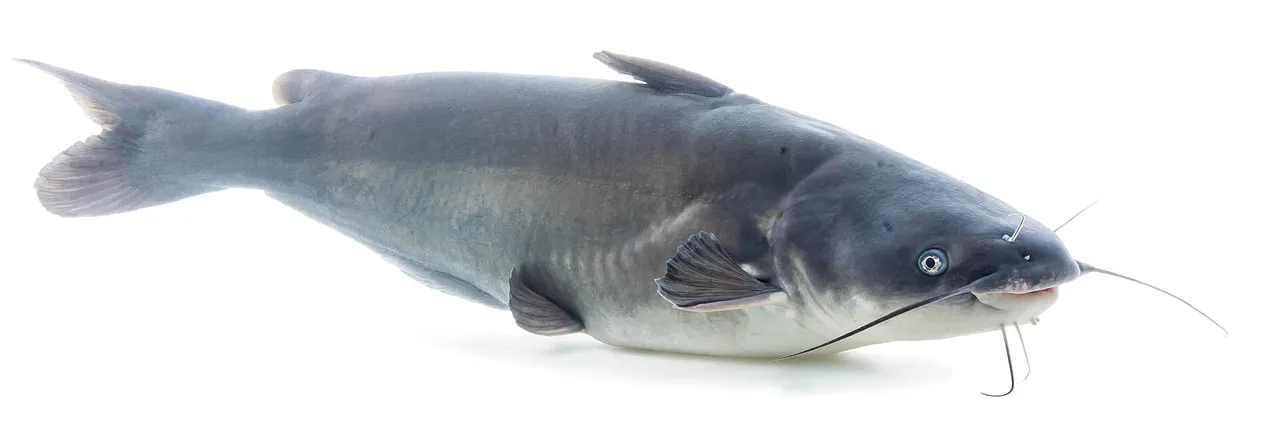
How this was identified, and who took it
Identified by: Identified on the two characters separating blue from channel catfish, both legible: the anal fin is long-based with a STRAIGHT rather than rounded lower margin, and the flank is uniformly unspotted where an adult channel catfish usually retains dark spots. The deeply forked caudal is consistent with both and does no diagnostic work. Photographed on a plain background by a named USFWS photographer at a hatchery, so the subject is a known animal rather than an inferred one.U.S. Fish and Wildlife Service — public domain, via Wikimedia Commons — source, licenceWhat is known about how it feeds
The blue catfish is a large, mobile, current-oriented feeder, and its principal food source is one that dies in large numbers on a schedule.
The verified relationship is gizzard shad, the dominant forage fish across the reservoir and large-river systems the species occupies. Shad are taken alive, and they are also taken dead in quantity: winter cold snaps kill gizzard shad in large numbers, and the resulting die-offs are a predictable and substantial feeding event that blue catfish exploit directly.
That willingness to take dead prey is the practically important difference from the flathead catfish sharing the same water, which takes live fish almost exclusively.
The sensory arrangement supports it. Catfish carry taste receptors across the body surface and concentrated in the barbels, so a blue catfish locates food by chemical trail in turbid water and in complete darkness, and does not need to see anything.
Mobility is the other characteristic. Blue catfish move considerable distances seasonally, following forage and temperature, and are more current-oriented than the other large American catfish — holding in and beside main channel flow rather than in slack cover.
The species has been introduced widely outside its native range and is a documented problem in several systems, where it preys heavily on native fish and shellfish.
The food
Prey with a verified dietary link to this fish. Each entry carries its own evidence, and each is written at the precision the source actually used: a named species where the source named one, a group or food category where it said “polychaetes”, “crustaceans” or “detritus” and meant it. That is why this list is shorter than the animal’s real diet rather than longer.
- Gizzard shad — Dorosoma cepedianum
Gizzard shad are the dominant prey of blue catfish in the reservoir systems where both occur, and winter shad die-offs are a substantial feeding event for them.
Food with no page of its own here yet
These are real components of the diet, listed as plain text because FishingHQ has no page for them yet. Inventing pages to make the list look fuller would be the fabrication this whole approach exists to prevent.
- threadfin shad
- skipjack herring
- freshwater mussels
- crayfish
- carrion and discards
- blue crabs, in brackish reaches
What anglers do with this
Everything below is interpretation, not finding. It is what experienced anglers conclude from the biology above, and the reasoning is usually sound and almost never tested. It is separated from the biology deliberately.
The willingness to take dead prey is the fact the fishery is built on, and it separates the approach from flathead fishing on the same water: cut and dead offerings work for blue catfish and are largely ignored by flatheads.
The winter shad die-off converts into a season, and anglers time effort around it. That is practitioner knowledge resting on a documented feeding event.
The chemosensory profile is the reasoning behind offerings that release scent, fished in current where the trail is carried. It is convention with a clear biological basis.
Where the species is introduced, its effect on native fish is a live management concern and moving live fish is restricted in many jurisdictions.
What this does not establish
One relationship for an opportunistic omnivore that also takes mussels, crustaceans and carrion. Composition varies with river and reservoir system and with the size of the fish, and nothing here establishes proportions.
Where this connects
These are the baits, lures, methods and explainers FishingHQ already joins to this fish — which is why the list is sometimes short. They are not chosen for this page, and a link here means an evidenced relationship exists, not that it follows from the diet.
Methods used for it
This page covers feeding. The Blue catfish record covers identification, lifecycle, seasonal behaviour, handling and the sources behind all of it.
Reviewed 2026-08-12.