What does channel catfish eat?
What is established about how channel catfish feeds, kept separate from what anglers infer from it.
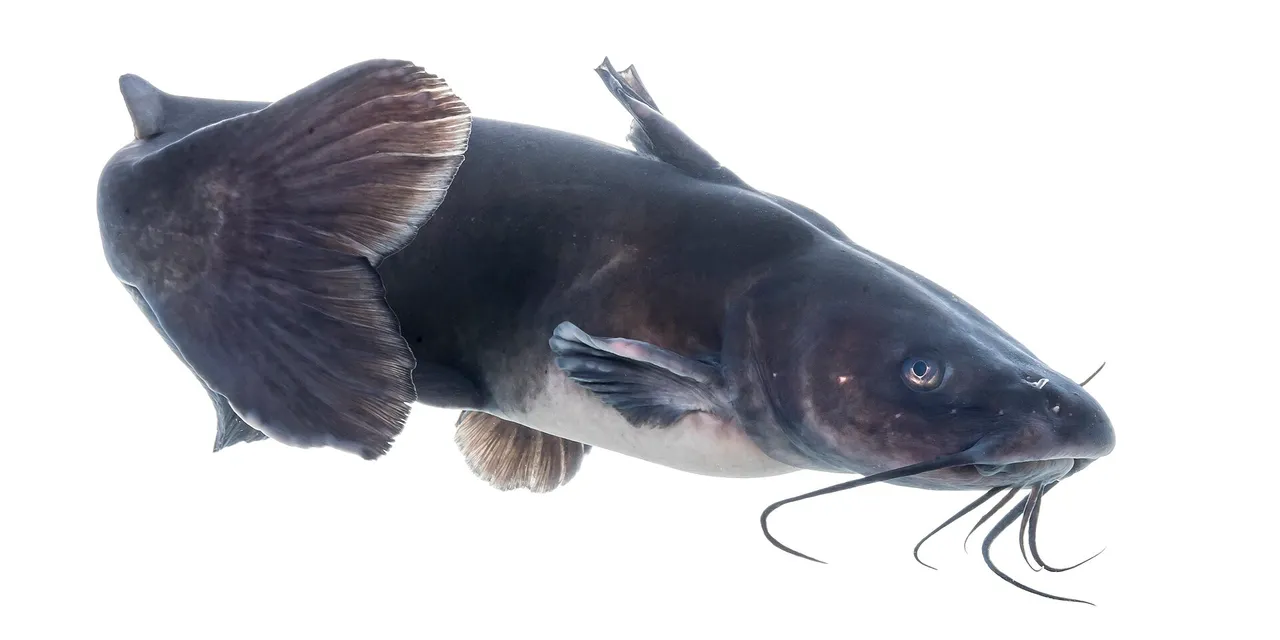
How this was identified, and who took it
Identified by: Whole fish on white. Deeply forked tail, barbels, adipose fin and the rounded free margin of the anal fin — the last being the character that separates it from blue catfish.USFWS Mountain Prairie — Public domain, via Wikimedia Commons — source, licenceWhat is known about how it feeds
The channel catfish is the omnivore of the three large American catfish, and its diet is the broadest and the least specialised of the three.
The verified relationship is aquatic insect larvae at group level, and it reflects the fact that invertebrates dominate the diet for much of the fish's life. Small fish, crayfish, molluscs, plant material and carrion all feature, and the balance shifts towards fish as the animal grows without ever becoming exclusive.
The sensory arrangement is the family's and it is remarkable. Taste receptors are distributed across the entire body surface as well as concentrated in the barbels, so the fish is effectively tasting the water it swims through. That is what allows a channel catfish to locate food in complete darkness, in heavy turbidity and in water where no visual predator could operate.
The consequence is a fish that finds food by following chemical gradients rather than by searching visually, which is why it is catchable on offerings that appeal to no other sense.
Activity is largely crepuscular and nocturnal, though the species feeds by day in coloured water.
Channel catfish are the most widely stocked catfish in North America and have been introduced well beyond their native range, which means a great deal of what is caught is in water the species did not originally occupy.
The food
Prey with a verified dietary link to this fish. Each entry carries its own evidence, and each is written at the precision the source actually used: a named species where the source named one, a group or food category where it said “polychaetes”, “crustaceans” or “detritus” and meant it. That is why this list is shorter than the animal’s real diet rather than longer.
- Aquatic insect larvae as prey — a group rather than a species: the evidence names the group
Channel catfish are omnivores with a diet dominated by invertebrates for much of their lives, shifting towards fish as they grow.
Food with no page of its own here yet
These are real components of the diet, listed as plain text because FishingHQ has no page for them yet. Inventing pages to make the list look fuller would be the fabrication this whole approach exists to prevent.
- small fish including shad and sunfish
- crayfish
- molluscs
- plant material and seeds
- carrion
What anglers do with this
Everything below is interpretation, not finding. It is what experienced anglers conclude from the biology above, and the reasoning is usually sound and almost never tested. It is separated from the biology deliberately.
The whole-body chemoreception is the reasoning behind the tradition of strongly scented preparations for this species, which is one of the most distinctive bait cultures in angling and is unusually well grounded: the sensory basis for it is documented rather than assumed.
The nocturnal weighting converts into a timing expectation, and the tolerance of turbidity into a conditions one — channel catfish remain catchable in coloured water that shuts down sight-feeding species.
The breadth of the diet is used to argue that this is a species where offering type matters less than scent delivery and placement, which is convention rather than a tested comparison.
What this does not establish
One group-level relationship for a genuine omnivore whose diet includes fish, molluscs, plant material and carrion, none of which is represented. Composition varies with water body, season and fish size, and a large share of the population is stocked. Nothing here establishes proportions.
Where this connects
These are the baits, lures, methods and explainers FishingHQ already joins to this fish — which is why the list is sometimes short. They are not chosen for this page, and a link here means an evidenced relationship exists, not that it follows from the diet.
Methods used for it
This page covers feeding. The Channel catfish record covers identification, lifecycle, seasonal behaviour, handling and the sources behind all of it.
Reviewed 2026-08-12.