How to identify common limpet
Patella vulgata · Patellidae
The characters that identify common limpet, ranked by how far each one can be trusted on its own.
Safety: cliffs and rock platforms — can cause serious injury or death. 2 more points apply here.
How this was identified, and who took it
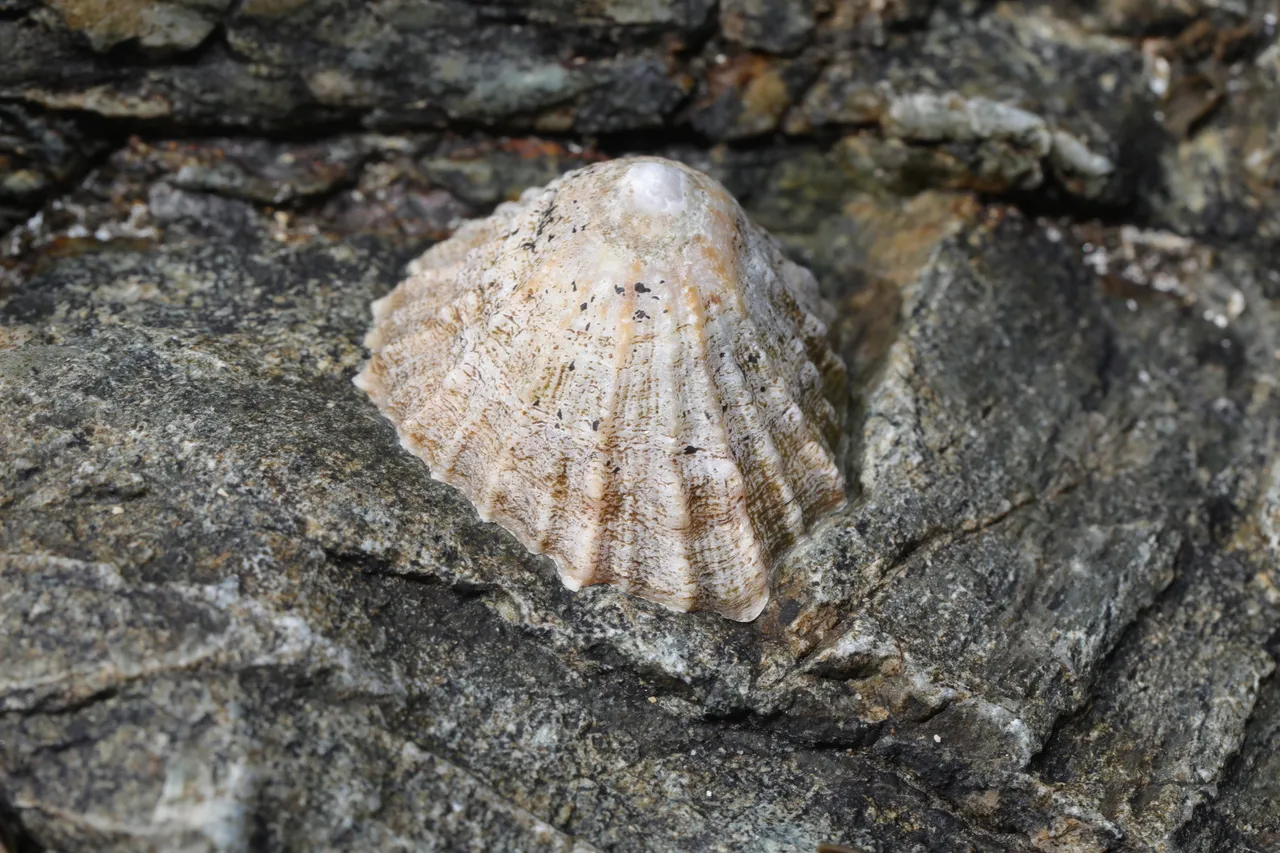
Identified by: The record's character is exactly what the frame shows: a simple conical shell with NO SPIRAL, roughly four centimetres across, ribbed in coarse radiating ridges from a slightly off-centre apex down to a scalloped margin bedded against the rock. This replaces two earlier candidates for this species, both of which were photographs of limpet home scars rather than limpets.Stephen James McWilliam — CC0, via iNaturalist — source, licenceAbout the image above: The photograph shows the animal in place on rock from above, which is the view that cannot resolve the species. The shell interior and the foot — the characters that would separate this from china limpet and black-footed limpet — are against the stone and not visible.
Look at this first
Ask one question before any other: does the shell spiral? A limpet's does not. It is a plain cone, ribbed from the tip down to the rim, sitting flat and hard against rock, and that single fact separates it from every winkle, topshell and whelk on the same stretch of shore no matter what colour any of them happen to be.
Diagnostic — settles it on its own
Each of these settles the identification on its own. If one is clear, you have your answer.
A plain cone with no spiral whorls
Look at the apex and follow the shell down. There is no coiling, no whorl and no visible suture — just ridges radiating from a point near the top to a rim that meets the rock all the way round. Every other common British shore gastropod a reader might pick up, winkles and topshells and dogwhelks alike, is built from a visible spiral. This is the character that places the animal, and it works from a metre away.
Supporting — use with other characters
Real characters that are not conclusive by themselves. Use two or three together.
Coarse ridges running apex to margin, scalloping the rim
The radiating ribs raise the shell edge into a shallowly toothed or scalloped margin where they reach it. On an old animal from an exposed shore the outside is heavily eroded and encrusted and the ribs can be almost worn away; on a younger shell they are sharp. Ribbing is a family character rather than a species one, so it confirms that this is a true limpet rather than a slipper limpet or a keyhole limpet, both of which are built differently.
Clamped, and effectively immovable when it knows you are there
An undisturbed limpet sits slightly raised; a disturbed one pulls down so hard that it cannot be prised off by hand and grinds its own scar into the rock. That behaviour is diagnostic of the group and is also the reason identification below family level is difficult in the field, because the characters that separate the species are underneath.
Suggestive only — varies with condition
Hints only. These vary with condition, season, water and how long the fish has been out of it, and a fish that contradicts them is still the same species.
Shell profile reflects height on the shore, not species
Animals high on the shore grow tall and narrow because they lose more water and must seal harder; animals low on the shore grow flatter and wider. A tall limpet and a flat limpet from the same rock can be the same species, so shape alone is not evidence of anything except where the animal has been living.
What it gets confused with
- China limpet and black-footed limpet, which share British rocky shores and cannot be separated from common limpet by a view from above; the difference is in the shell interior and the colour of the foot.
- Slipper limpet, an introduced species which is cone-like from above but carries an internal shelf across half the aperture and is usually found stacked in chains rather than clamped alone to rock.
- Keyhole and tortoiseshell limpets, which have a hole or a slit at or near the apex — look at the tip before anything else.
- Barnacles, at a glance and at distance, which are cemented permanently and built from separate plates rather than one piece.
Side by side: Common limpet vs Common periwinkle.
Where this stops working
A view from above cannot name the species. Common limpet, china limpet and black-footed limpet all occur together on many British and Irish shores and are separated on the colour of the foot and on the pattern inside the shell, both of which require the animal to be removed from the rock. Removing a limpet usually kills it, because it cannot re-attach reliably once its seal is broken and because the grip is strong enough that prising damages the shell edge. So the honest position is: the group is unmistakable, the species frequently is not, and a reader who does not need the species should not lift the animal to get it. Limpet gathering is regulated in many places and closed in some; that is a question for the relevant authority and the local shellfish classification, and never for a photograph.
The full record
This page covers identification only. The Common limpet record covers behaviour, lifecycle, distribution, handling and the sources behind all of it.
Reviewed 2026-08-16.
More about this fish
Telling it apart is one question. Here are the others.
Similar and related fish
How it is caught
Where it lives
Why the 4 connections on this page are here, and the sources
Similar and related fish
Backed by research — 2 connections
Supported by peer-reviewed research or fisheries science. The sources are listed and can be checked.
Canary black limpet
Patella candei A. d'Orbigny, 1840 is a Macaronesian species. Patella vulgata is a northern European one and does not occur in the Canaries or Madeira. They are not distinguished in the field so much as by ocean, and the practical consequence is regulatory rather than biological: the Macaronesian animal carries a legal minimum size and a closed season, and the northern one does not.
- WoRMS — the World Register of Marine Species — WoRMS Editorial Board, hosted by the Flanders Marine Institute (VLIZ) (Scientific institute)Relied on for: The accepted names, naming authorities, taxonomic status, synonymy and families that separate these animals from one another.States this directlyPassage read and verified
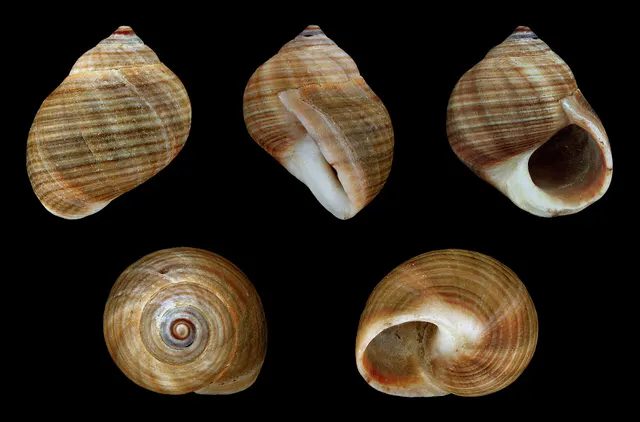
Common periwinkle
Two marine gastropods of the same habitat and the same gathering practice, joined so a reader can move between them.
- FishBase: a global information system on fishes — Froese, R. and D. Pauly, eds. — FishBase Consortium (Scientific institute)Relied on for: Distribution, habitat association and life history recorded for Buccinum undatum, Patella vulgata and Littorina littorea, including the rocky and soft-ground habitats each occupies.States this directlyPassage read and verified
- The IUCN Red List of Threatened Species — International Union for Conservation of Nature (Conservation authority)Relied on for: Assessment and range accounts for north-east Atlantic marine gastropods including Littorina littorea, and the habitats and pressures recorded for them.Background and mechanism onlyCitation checked — the work exists and is described correctly
How it is caught
What experienced anglers do — 1 connection
Widely and independently recommended by experienced anglers and specialist sources. This is real angling knowledge, not proof: controlled evidence for it is limited, and FishingHQ records it as convention rather than as a demonstrated effect.
Gathering winkles, whelks and limpets
An established gathering practice for this species, recorded as the convention it is rather than as a tested claim.
- General angling website restatements of established technique — Various (Credible secondary source)Relied on for: Widely restated practice associating this discipline with this place, recorded as practitioner consensus rather than as tested fact.Background and mechanism onlyCitation checked — the work exists and is described correctly
- Fishers' Craft and Lettered Art: Tracts on Fishing from the End of the Middle Ages — University of Toronto Press, 1997 (Scientific literature)Relied on for: That fishing traditions develop around the water and fish available to them, and the historical method of reading such traditions.States this directlyCitation checked — the work exists and is described correctly
Where it lives
Backed by research — 1 connection
Supported by peer-reviewed research or fisheries science. The sources are listed and can be checked.
Rocky shores and reefs
A distribution association between an animal and a kind of water, rather than a claim about any named mark.
- FishBase: a global information system on fishes — Froese, R. and D. Pauly, eds. — FishBase Consortium (Scientific institute)Relied on for: Distribution, habitat association and depth range recorded for the species, including its occurrence in the water body concerned.States this directlyPassage read and verified
- The IUCN Red List of Threatened Species — International Union for Conservation of Nature (Conservation authority)Relied on for: Assessment and range account for the species, including the systems and coasts it occupies.Background and mechanism onlyCitation checked — the work exists and is described correctly
A claim that a place contains the ground and conditions the animal is associated with. It is a distributional statement about the world and rests on reference works, and it deliberately asserts nothing about access or permission.
- The Fishes of the British Isles and North-West Europe — Macmillan, 1969 (Reference work)Relied on for: Distribution and habitat association of the inshore fauna of the British Isles and the north-east Atlantic.States this directlyCitation checked — the work exists and is described correctly
- FishBase: a global information system on fishes — Froese, R. and D. Pauly, eds. — FishBase Consortium (Scientific institute)Relied on for: Recorded distribution and habitat association for the species where held.Background and mechanism onlyPassage read and verified
- The IUCN Red List of Threatened Species — International Union for Conservation of Nature (Conservation authority)Relied on for: Range and recorded threats for the species where assessed.Background and mechanism onlyCitation checked — the work exists and is described correctly
Safety
Cliffs and rock platforms — Can cause serious injury or death
The best limpets grow low on exposed rock in the surge zone, so gathering them puts a person at the water's edge on wet rock with their attention down and their back to the sea. Being swept off by a set wave substantially larger than those preceding it is the characteristic accident, and it has a serious fatality record wherever limpets are prized.
What reduces it: Watch a full set of waves before committing to any ledge, read swell height and period rather than wind, stay higher on the shore than feels necessary, never turn your back on the sea, wear a buoyancy aid on exposed rock, and gather with somebody who can raise help.
Worse when:
- Any swell running, including on a windless sunny day, because ground swell arrives with no local warning.
- A rising tide, which brings the break progressively further up the rock.
- Unfamiliar ground, where which ledges are workable at which swell is entirely local knowledge.
Tides and being cut off — Can cause serious injury or death
Shore gathering is done on a falling tide with attention on the ground rather than on the water, and the flood returns across level rock and sand faster than a person expects, filling channels behind before covering the ground underfoot.
What reduces it: Know the time of low water and the time you intend to leave before starting, and leave at that time rather than when the gathering slows. Identify the route back and the channel that will close first. Do not gather alone on unfamiliar ground.
Slips, trips and falls — Can cause injury needing treatment
Gathering is done on wet, weed-covered, uneven rock while looking down and moving constantly, which is the combination that produces falls onto hard ground.
What reduces it: Studded or well-gripped footwear, weight kept low, and no hurrying between rocks. Test weed-covered surfaces before committing weight.