Striped red mullet
Fish · Last reviewed 2026-08-10
A red and gold bottom-feeding fish that hunts with a pair of long chin barbels, unrelated to grey mullet and among the most prized European table fish.
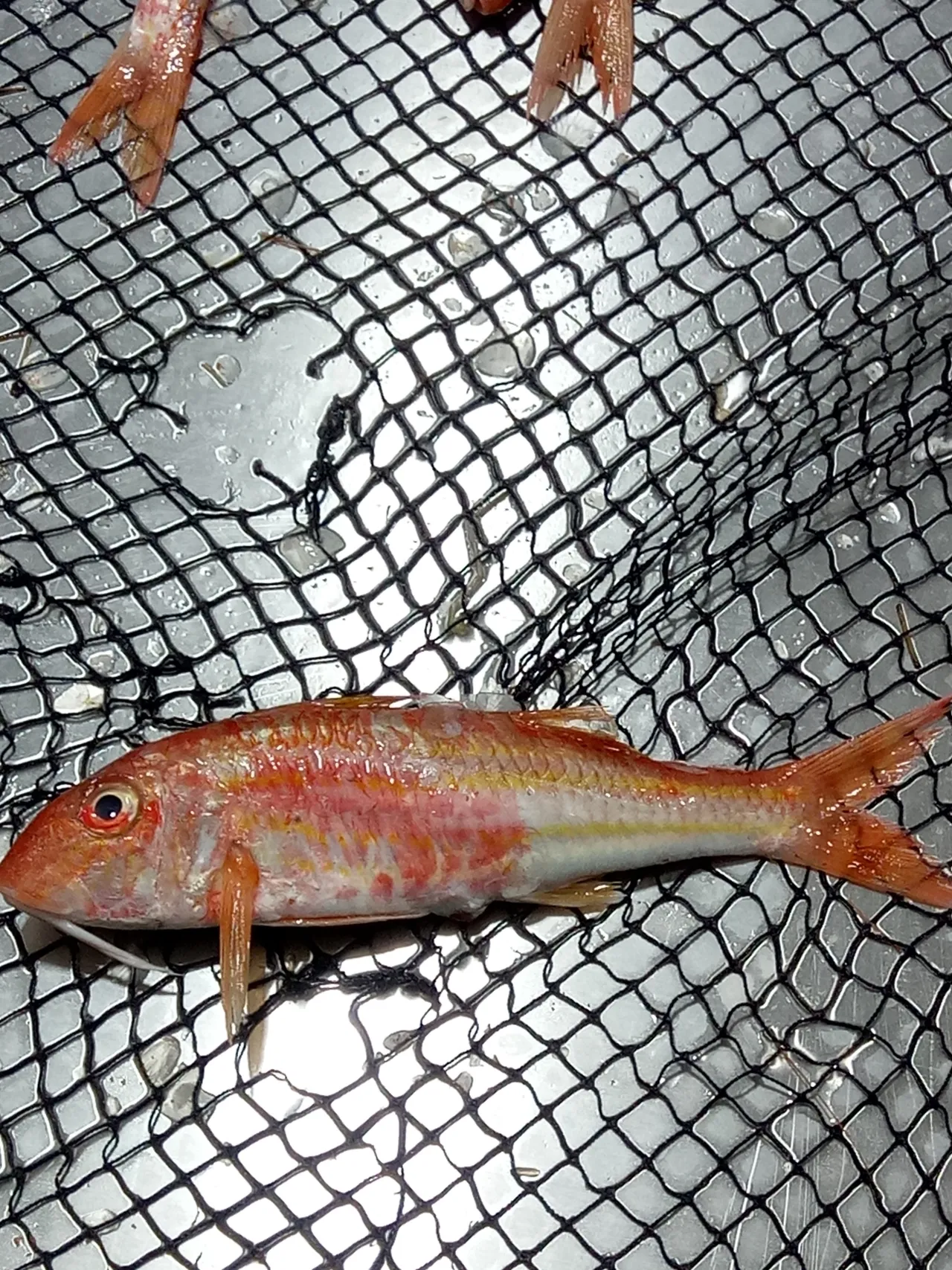
How this was identified, and who took it
Identified by: Two long separate chin barbels, which place the fish in the Mullidae; distinct yellow longitudinal stripes along the flank and a sloping rather than steeply blunt snout profile, which together point to Mullus surmuletus rather than Mullus barbatus. Three agreeing identifications on the source, none disagreeing.Karim Haddad — CC BY, via iNaturalist — source, licenceCatching Striped red mullet
Everything here on fishing for it. Each entry opens the page behind it.
- When
- Mar and Jun–Sept — months recorded at the places that document it, not a season for the whole range.
- Where
- 3 places FishingHQ documents — strongest claim anywhere: seasonal · From the shore
Striped red mullet is not a mullet. It belongs to the goatfishes, and the resemblance to grey mullet is entirely superficial — this is a small, brilliantly coloured bottom feeder with two long barbels under the chin that it uses to probe sand for buried invertebrates.
Those barbels are the whole animal. A feeding red mullet works over sand and mixed ground with the barbels extended, detecting prey by touch and chemical sense rather than sight, and the fish's habit of stirring sediment attracts other species that follow it to feed on what it disturbs.
It is among the most highly valued table fish in Europe and has been since antiquity, which is a genuine and well-documented piece of culinary history rather than a marketing claim.
How it is caught
Where Striped red mullet is documented
Places where public sources describe this species as fished, with how it is fished and how strongly the evidence supports it. This is not a range map and it is not a recommendation — it is what has been written down about a fishery rather than a record of any individual catch, and being listed is never permission to fish.
The Cornish and Devon coasts
1 documented place
Headland
Seasonal
From the shore
Around Jun, Jul, Aug, Sept
The Azores
1 documented place
Vila Franca do Campo, São Miguel
Harbour wall
Recorded here
From the shore
Around Mar
What these strengths mean
- Recorded here
- At least one credible public account of this species being caught here. That is all it means.
- Seasonal
- Well supported, and concentrated in part of the year rather than spread through it.
Identification
- Scientific name
- Mullus surmuletus
- Family
- Mullidae
- Water
- Saltwater
- Conservation status
- Least Concern
- Regions
- Mediterranean, Western Europe, Britain & Ireland
- Two long barbels beneath the chin, used to probe sediment — absent in grey mullets, which are unrelated.
- Red to rose body with a distinct yellow-gold longitudinal stripe along the flank.
- A dark reddish-brown stripe running through the first dorsal fin.
- Steep, almost vertical forehead profile with the eye set high.
Size
- Typical
- 150–400 g (5–14 oz)
- Large
- 600 g–1 kg (1.3–2.2 lb)
Exceptional: FishBase records a maximum of 40 cm and 1 kg
Lifecycle and reproduction
Fast-growing and relatively short-lived, maturing within a year or two. Populations in the northern part of the range have expanded in recent decades, a change linked to warming coastal water.
Spawns in late spring and summer in coastal waters, broadcasting pelagic eggs. Juveniles are pelagic before settling onto sandy bottom.
Feeding and senses
Probes sand and mixed ground with the chin barbels for worms, crustaceans and molluscs, detecting prey by touch and chemical sense rather than by sight.
Relies on chemoreception and touch through the barbels rather than on vision, which is why it feeds effectively over featureless sediment and why scented natural baits are the practical approach.
Through the year
Moves inshore into shallow sandy ground in the warmer months and offshore into deeper water in winter. Its northward extension into British waters is seasonal and has become more consistent.
Distribution
Eastern Atlantic: Western Norway, English Channel (rare in North Sea) to Dakar, Senegal and the Canary Islands, including the Mediterranean and the Black Sea
This is a biological range — where the species occurs, not a prediction that you will catch one. To browse the fishing geography FishingHQ holds, start at fishing places.
Why anglers care
A light-tackle bottom species taken on small hooks baited with ragworm and shellfish over clean sand, from boat and shore across the Mediterranean and increasingly in northern European waters. Its significance is largely culinary — it is among the most valuable European table fish — and its increasing appearance in British catches is a visible indicator of warming coastal seas.
Handling and returning
Small, delicate and quick to lose colour and condition. Handle with wet hands, unhook with a disgorger, and return promptly. The first dorsal has sharp spines.
Where to go next
Where it lives
Where you will find it
More fish
Not related to this page — just the rest of the section. There is little else joined to this subject yet, and a short page should still lead somewhere.
Sources and evidence
- FishBase: a global information system on fishes — Froese, R. and D. Pauly, eds. — FishBase Consortium (Scientific institute)Relied on for: Family, maximum size, depth and environment, distribution and the IUCN assessment for Mullus surmuletus.States this directlyPassage read and verified
- The IUCN Red List of Threatened Species — International Union for Conservation of Nature (Conservation authority)Relied on for: The Least Concern assessment for Mullus surmuletus, assessed 14 July 2014.States this directlyCitation checked — the work exists and is described correctly
Why the 6 connections on this page are here, and the sources
How it is caught
What experienced anglers do — 1 connection
Widely and independently recommended by experienced anglers and specialist sources. This is real angling knowledge, not proof: controlled evidence for it is limited, and FishingHQ records it as convention rather than as a demonstrated effect.
Ledgering
A practitioner claim about how Mullus surmuletus is commonly fished, following from where and how it feeds.
- General angling website restatements of established technique — Various (Credible secondary source)Relied on for: Widely restated practitioner accounts of fishing for striped red mullet.Citation checked — the work exists and is described correctly
- Sea Angler — Bauer Media (Specialist angling publication)Relied on for: Practitioner treatment of the methods used for striped red mullet and comparable species.Citation checked — the work exists and is described correctly
Official guidance — 1 connection
Stated by a fisheries authority, scientific institute or recognised angling body. Authoritative, but summarising rather than demonstrating.
Shore diving
A scientific institute reporting what its own survey of the fishery recorded: a two-year catch-recording programme across the Canary archipelago counted and weighed every specimen, and this species appears in its published catch table. That is what Canary spearfishers were measured taking, rather than an inference from where the species lives or an assertion about what people do.
- Spearfishing in the Canary Islands: is the devil as black as it seems to be? — Pablo Martín-Sosa, Instituto Español de Oceanografía — Revista Scientia Insularum, 2019 (Scientific literature)Relied on for: The Canary spearfishing catch table, in which this species appears with a specimen count and a landed weight over the study's two-year recording period.States this directlyPassage read and verified
Gear for this fish
What experienced anglers do — 1 connection
Widely and independently recommended by experienced anglers and specialist sources. This is real angling knowledge, not proof: controlled evidence for it is limited, and FishingHQ records it as convention rather than as a demonstrated effect.
Ragworm
A practitioner claim about tackle commonly used for Mullus surmuletus.
- General angling website restatements of established technique — Various (Credible secondary source)Relied on for: Widely restated practitioner accounts of this presentation for striped red mullet.Citation checked — the work exists and is described correctly
- Angling Times — Bauer Media (Specialist angling publication)Relied on for: Practitioner treatment of comparable presentations for the species group.Citation checked — the work exists and is described correctly
Where it lives
Backed by research — 2 connections
Supported by peer-reviewed research or fisheries science. The sources are listed and can be checked.
Inshore ground
A habitat association for Mullus surmuletus taken from the environment and distribution data on its FishBase summary.
- FishBase: a global information system on fishes — Froese, R. and D. Pauly, eds. — FishBase Consortium (Scientific institute)Relied on for: The environment, depth range and habitat description recorded for Mullus surmuletus.States this directlyPassage read and verified
Surf beaches
A habitat association for Mullus surmuletus taken from the environment and distribution data on its FishBase summary.
- FishBase: a global information system on fishes — Froese, R. and D. Pauly, eds. — FishBase Consortium (Scientific institute)Relied on for: The environment, depth range and habitat description recorded for Mullus surmuletus.States this directlyPassage read and verified
Where you will find it
Backed by research — 1 connection
Supported by peer-reviewed research or fisheries science. The sources are listed and can be checked.
The Isles of Scilly
A claim that a place contains the ground, water and seasonal conditions the species is associated with. It is a distributional statement about the world, it rests on the regional reference literature, and it deliberately asserts nothing about access, permission or catch.
- The Fishes of the British Isles and North-West Europe — Macmillan, 1969 (Reference work)Relied on for: Distribution and habitat association of the marine, estuarine and freshwater fishes of the British Isles, including which coasts, estuaries and ground types a species occupies.States this directlyCitation checked — the work exists and is described correctly
- FishBase: a global information system on fishes — Froese, R. and D. Pauly, eds. — FishBase Consortium (Scientific institute)Relied on for: Recorded distribution, depth range and habitat association for the species named.States this directlyPassage read and verified
How FishingHQ labels evidence is explained in the evidence policy.