Common whelk
Fish · Last reviewed 2026-08-14
A large predatory and scavenging sea snail of soft ground, taken in baited pots in one of the north Atlantic's more valuable inshore fisheries, and a scavenger rather than a filter feeder.
Safety: boat safety — can cause serious injury or death. 2 more points apply here.
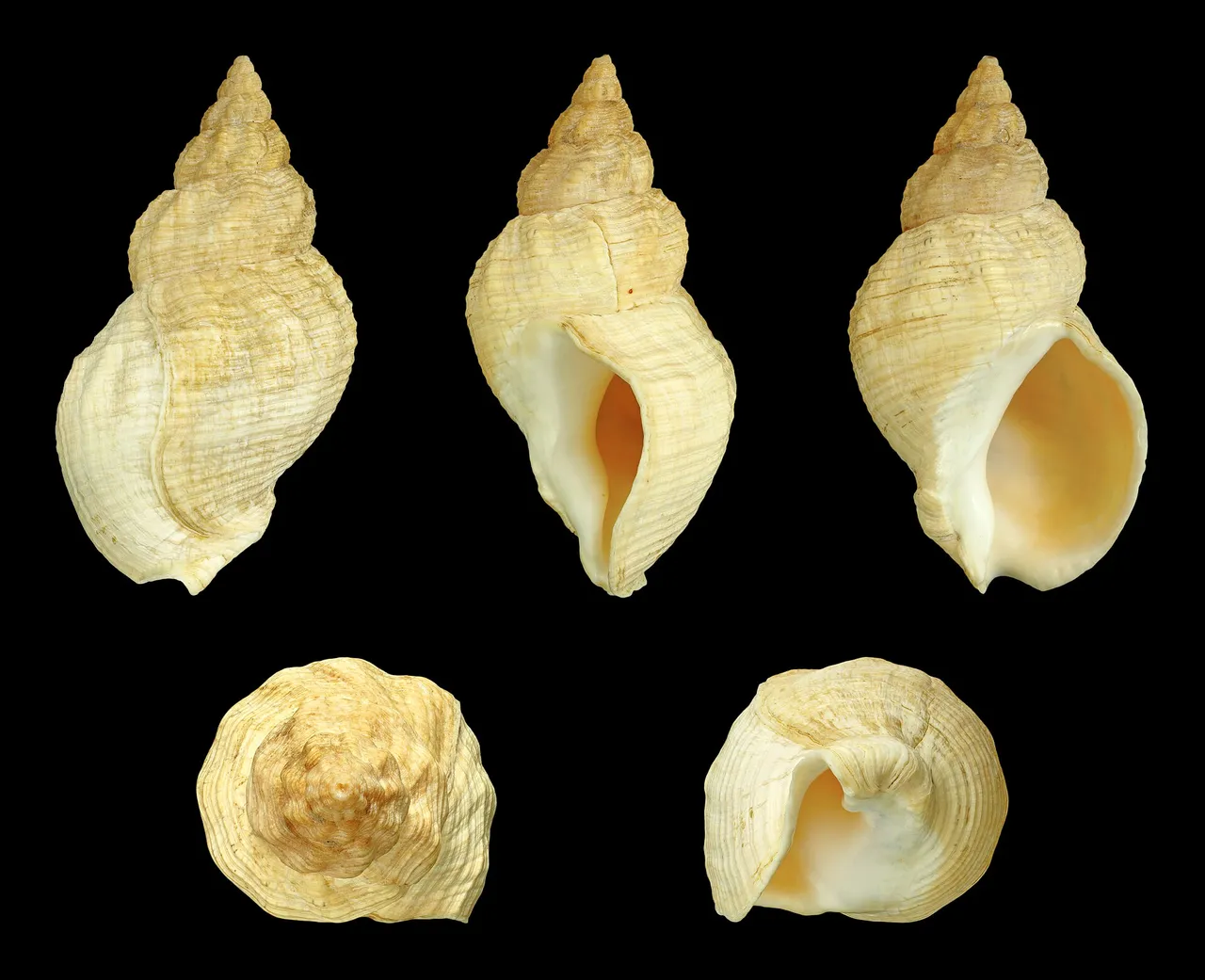
How this was identified, and who took it
Identified by: Identified on shell sculpture and outline, which for a gastropod IS the identification: a fusiform shell with a tall spire, strong spiral cords crossed by broad axial undulations — the 'undatum' it is named for — a large ovate aperture with an orange interior, and a short siphonal canal with a distinct notch. Five studio views show every one. RECORDED AS AN EMPTY SHELL, which is what a gatherer will be holding.H. Zell — CC BY-SA 3.0, via Wikimedia Commons — source, licence
Catching Common whelk
Everything here on fishing for it. Each entry opens the page behind it.
- Ground
The common whelk is the large, ridged, pale sea snail that most people meet boiled on a seaside stall without ever seeing alive. It lives on sand, mud and mixed ground from the low shore down to considerable depth, and it is a predator and scavenger rather than a grazer or a filter feeder — a distinction that decides both how it is caught and how its safety profile should be read.
IT IS CAUGHT BECAUSE IT SMELLS FOOD FROM A DISTANCE. A whelk locates carrion by chemoreception through its siphon and moves towards it over the bottom, and that behaviour is the entire basis of the pot fishery: a baited pot on soft ground draws whelks in from a wide area and holds them. No other British shellfish fishery depends so completely on a single sensory behaviour.
IT IS ALSO A PREDATOR OF OTHER SHELLFISH, drilling or forcing bivalves and taking damaged animals, which makes it an ecological actor on the grounds it occupies rather than a passive resident.
THE FISHERY IS LARGER THAN MOST PEOPLE REALISE. Whelk is a significant inshore commercial fishery in Britain and Ireland and around the north Atlantic, with much of the catch exported to markets in East Asia, and it has been subject to concern about undersized landings and slow stock recovery.
AND IT IS SLOW-GROWING AND LATE-MATURING, which is the usual combination behind a shellfish that depletes easily. Minimum landing sizes have been raised in several areas on exactly that basis.
Identification
- Scientific name
- Buccinum undatum
- Family
- Buccinidae
- Water
- Saltwater
- Conservation status
- Not assessed
- Regions
- Britain & Ireland, Northern Europe, Western Europe, North America, Arctic & Subarctic
- A large, thick, spirally ridged conical shell, typically 5–10 cm high, chalky white to pale brown.
- A distinct siphonal canal — a notch at the front of the aperture — through which the animal extends its siphon to smell.
- A horny operculum sealing the aperture when the animal withdraws.
- Distinguished from the dog whelk, which is much smaller, blunter and lives on rocky shores, and from the netted dog whelk of sandy ground.
- Found on sand, mud and mixed bottoms from the low shore to well offshore, rather than on the rocky shore where winkles and limpets live.
Size
- Typical
- 6–8 cm shell height.
- Large
- Over 10 cm.
Exceptional: Shell heights around 12 cm are recorded in cold northern water. Growth rate and size at maturity vary substantially between grounds, which is why a single minimum landing size across a wide area is a poor fit.
Where whelks live, and why it is never the lobster ground
Whelks occupy soft and mixed seabed — sand, mud, gravel and shell — from the low intertidal down to several hundred metres, and the substrate preference is the single most useful thing to know about them.
THE BOTTOM HAS TO BE WALKABLE AND SCENTABLE. A whelk moves over the seabed on a muscular foot, tracking a scent plume, so it needs a surface it can cross. Broken rock and heavy kelp are poor whelk ground; open sand and mud are good. That is why a pot string set on a reef catches crabs and nothing else, and why whelk grounds and lobster grounds are different places on the same coast.
DEPTH IS BROAD AND TEMPERATURE-BOUNDED. The species occupies a wide depth range but is a cold-water animal: it is scarce at the southern edge of its range and abundant in the north, and warming has been implicated in range contraction at the southern margin.
JUVENILES AND ADULTS SHARE GROUND, which is unusual for a marine invertebrate and follows from the absence of a planktonic larval stage. Young whelks emerge from egg capsules as miniature adults onto the ground where the capsules were laid, so a population is genuinely local.
AND HARD SUBSTRATE STILL MATTERS FOR ONE THING. Egg masses need something firm to attach to — stone, shell, wreck or gear — so a ground that is uniformly soft with no hard fragments may hold feeding animals and no spawning ones.
Backed by research — why, and the sources (2)
Supported by peer-reviewed research or fisheries science. The sources are listed and can be checked.
- FishBase: a global information system on fishes — Froese, R. and D. Pauly, eds. — FishBase Consortium (Scientific institute)Relied on for: Distribution, habitat association, depth range, size, reproduction and life-history parameters recorded for the species.States this directlyPassage read and verified
- The IUCN Red List of Threatened Species — International Union for Conservation of Nature (Conservation authority)Relied on for: Assessment and range account for the species, including the habitats it depends on, its life history and the pressures acting on it.States this directlyCitation checked — the work exists and is described correctly
Egg capsules, sibling cannibalism and no larval drift
Whelk reproduction is unusual among marine snails and the difference is what makes the species so easy to deplete.
SEXES ARE SEPARATE AND FERTILISATION IS INTERNAL. Animals aggregate to mate and to lay, and females deposit a spongy mass of tough egg capsules attached to stone, shell, wreck or fishing gear — the masses that wash up and are sometimes called sea wash balls.
MOST OF THE EGGS ARE FOOD. Each capsule contains many eggs of which only a small minority develop; the rest are consumed by their developing siblings. That is the strategy: fewer, larger, better-provisioned young rather than many small ones.
AND THERE IS NO PLANKTONIC LARVAL STAGE. Juveniles crawl out of the capsule as miniature whelks. This is the fact that governs everything about the fishery: with no drifting larvae, a ground that is cleared cannot be restocked from a neighbouring population. Recovery depends entirely on the animals left behind.
MATURITY IS LATE AND SIZE AT MATURITY VARIES BY GROUND, sometimes substantially over short distances. A single minimum landing size applied across a wide area will therefore protect breeding stock in one place and not in the next, which is why several administrations have raised or regionalised the size.
SPAWNING AGGREGATIONS CONCENTRATE THE ANIMALS at precisely the point in the cycle when removing them costs most, which is the recurring vulnerability of any aggregating spawner.
Backed by research — why, and the sources (2)
Supported by peer-reviewed research or fisheries science. The sources are listed and can be checked.
- FishBase: a global information system on fishes — Froese, R. and D. Pauly, eds. — FishBase Consortium (Scientific institute)Relied on for: Distribution, habitat association, depth range, size, reproduction and life-history parameters recorded for the species.States this directlyPassage read and verified
- The IUCN Red List of Threatened Species — International Union for Conservation of Nature (Conservation authority)Relied on for: Assessment and range account for the species, including the habitats it depends on, its life history and the pressures acting on it.States this directlyCitation checked — the work exists and is described correctly
A fishery that runs all year and a biology that does not
Whelks are potted year-round, and the seasonality is in the animal's activity rather than in its presence.
TEMPERATURE DRIVES ACTIVITY AND THEREFORE CATCH RATE. Whelks are more active in warmer water, move further to a scent and enter pots more readily, so catch per pot generally falls through the coldest months and rises as the water warms. The animals have not gone anywhere; they are moving less.
SPAWNING CONCENTRATES THEM SEASONALLY. Aggregations form to mate and lay, with timing varying across the range, and a fishery working an aggregation takes a disproportionate share of the breeding population. Where seasonal measures exist they are generally aimed at that.
SOME POPULATIONS MOVE INSHORE AND OFFSHORE SEASONALLY, which shifts where the pots go rather than whether they fish, and local knowledge of that movement is a large part of what an experienced potter knows.
MEAT YIELD AND CONDITION VARY THROUGH THE YEAR as the animals feed and then spawn, which matters to the market rather than to the biology.
AND THE FISHERY'S OWN SEASONALITY IS PARTLY WEATHER. Small-boat potting is limited by what can be safely hauled, so the effective season on an exposed coast is set by the number of workable days rather than by the whelks.
NOTHING HERE INDICATES WHEN ANY FISHERY IS OPEN. Closed periods, size limits and permit conditions are set by the relevant authority and are revised.
Backed by research — why, and the sources (2)
Supported by peer-reviewed research or fisheries science. The sources are listed and can be checked.
- FishBase: a global information system on fishes — Froese, R. and D. Pauly, eds. — FishBase Consortium (Scientific institute)Relied on for: Distribution, habitat association, depth range, size, reproduction and life-history parameters recorded for the species.States this directlyPassage read and verified
- The IUCN Red List of Threatened Species — International Union for Conservation of Nature (Conservation authority)Relied on for: Assessment and range account for the species, including the habitats it depends on, its life history and the pressures acting on it.States this directlyCitation checked — the work exists and is described correctly
How big whelks get, and why size varies so much between grounds
A common whelk typically reaches six to eight centimetres of shell height, with animals over ten centimetres large and shells around twelve centimetres recorded in cold northern water.
BUT THE USEFUL NUMBER IS SIZE AT MATURITY, NOT MAXIMUM SIZE. Whelks mature late, and the size at which they do so differs markedly between grounds — in some populations animals breed several centimetres smaller than in others a short distance away. The cause is not fully resolved and temperature, food supply and possibly fishing pressure itself are all implicated.
THAT VARIATION IS THE MANAGEMENT PROBLEM. A minimum landing size set from a national average will be above the local maturity size in some places, which protects the stock, and below it in others, which does not. Several administrations have raised the size or moved to regional sizes on exactly that reasoning, and the debate is live.
MEASUREMENT IS SHELL HEIGHT — apex to the end of the siphonal canal — rather than width or weight, and it is taken with a gauge rather than by eye.
GROWTH IS SLOW AND ANIMALS ARE LONG-LIVED, so a large whelk is an old whelk. Combined with no larval drift, that makes a cleared ground a slow recovery rather than a seasonal one.
Backed by research — why, and the sources (2)
Supported by peer-reviewed research or fisheries science. The sources are listed and can be checked.
- FishBase: a global information system on fishes — Froese, R. and D. Pauly, eds. — FishBase Consortium (Scientific institute)Relied on for: Distribution, habitat association, depth range, size, reproduction and life-history parameters recorded for the species.States this directlyPassage read and verified
- The IUCN Red List of Threatened Species — International Union for Conservation of Nature (Conservation authority)Relied on for: Assessment and range account for the species, including the habitats it depends on, its life history and the pressures acting on it.States this directlyCitation checked — the work exists and is described correctly
Handling whelks: riddling, tetramine and the glands that come out
Handling a whelk catch has three parts, and only one of them is about the fishing.
SORTING HAPPENS ABOARD, NOT ASHORE. Catch is riddled or gauged at the point of capture and undersized animals go straight back. An undersized whelk returned promptly and undamaged survives; one carried ashore in a bag does not, which makes sorting location the difference between a size limit that works and one that does not.
KEEP THEM COOL, DAMP AND BREATHING. Whelks travel alive in an unsealed container out of the sun. Sealed boxes and standing fresh water both kill them, and a dead whelk is not food.
THE TETRAMINE POINT IS THE ONE MOST PEOPLE DO NOT KNOW. Whelks accumulate tetramine, a naturally occurring compound concentrated in the salivary glands, which causes short-lived but genuinely unpleasant neurological effects — headache, blurred vision, nausea. The traditional preparation of removing the glands before eating exists for that reason and is not decoration. Cooking does not destroy it.
THE BIOTOXIN FRAMEWORK IS NOT THE PRIMARY ONE HERE. A whelk scavenges rather than filters, so it does not concentrate algal biotoxins the way a mussel or a cockle does. Microbiological risk from contaminated water applies as it does to anything taken from the sea.
AND COOKING IS BOILING, briefly. Overcooked whelk is rubbery and undercooked whelk is worse, and the animal should be purged in clean seawater and any that fail to withdraw when touched discarded before it goes anywhere near a pan.
Official guidance — why, and the sources (2)
Stated by a fisheries authority, scientific institute or recognised angling body. Authoritative, but summarising rather than demonstrating.
- Fish and Fishery Products Hazards and Controls Guidance — US Food and Drug Administration, Center for Food Safety and Applied Nutrition, 2022 (Standards body)Relied on for: Seafood hazards and controls, including microbiological and biotoxin risk in molluscan shellfish and the handling practices that bear on them.States this directlyPassage read and verified
- FishBase: a global information system on fishes — Froese, R. and D. Pauly, eds. — FishBase Consortium (Scientific institute)Relied on for: Distribution, habitat association, depth range, size, reproduction and life-history parameters recorded for the species.States this directlyPassage read and verified
Lifecycle and reproduction
Unusually for a marine snail, there is no planktonic larval stage. Eggs are laid in a characteristic spongy mass of capsules attached to hard substrate, and juveniles emerge as miniature crawling whelks. That matters enormously: with no drifting larvae, a depleted ground does not restock from elsewhere, and recovery depends on the animals that remain. Growth is slow and maturity is late.
Sexes are separate and fertilisation is internal. Females aggregate to lay egg masses on stones, shell and gear, each mass containing many capsules of which only a minority produce a hatchling — the rest are consumed by their siblings. Aggregation to spawn makes the animals locally concentrated and correspondingly catchable at exactly the wrong time.
Feeding and senses
A predator and scavenger. It detects carrion and damaged animals by chemoreception through an extended siphon, moves to the source over the bottom, and feeds with a proboscis. It also attacks live bivalves. This is the behaviour the pot fishery exploits, and it is also why the animal's contamination profile is a predator's rather than a filter feeder's.
Chemoreception is dominant and is unusually acute: the siphon is held up into the current and the animal tracks a scent plume to its source over a considerable distance. There is a simple light sense and a strong response to touch and to being lifted, when the animal withdraws and seals with the operculum.
Through the year
Present year-round and taken year-round, with activity and catch rates falling in the coldest water. Spawning aggregations form seasonally and concentrate animals, and several areas apply measures around that period. Whelks move onto shallower ground in some areas seasonally, which shifts where the pots go rather than whether they fish.
Distribution
North Atlantic on both sides, from the Arctic south to the Bay of Biscay in Europe and to the mid-Atlantic states in North America. Sand, mud and mixed ground from the low intertidal down to several hundred metres, with the fishery concentrated in shallower coastal water.
This is a biological range — where the species occurs, not a prediction that you will catch one. To browse the fishing geography FishingHQ holds, start at fishing places.
Why anglers care
Not an angling catch in the rod sense, and included because a guide that models catch as things people take from the sea cannot omit one of the north Atlantic's more valuable inshore shellfish fisheries. Whelks are also a bait: the foot is tough, holds on a hook and stays on in a tide, and it is a traditional cod and ray bait on grounds where whelks are landed.
Handling and returning
POTTING IS THE FISHERY. Baited pots are set in strings on soft ground and lifted after a soak of a day or more, and the whole method depends on the animal walking to a scent. Recreational potting is possible where permitted, and permitting for pots is exactly where the rules bite — pot numbers, tags, marking and permitted grounds are controlled in many areas and the position changes.
SIZE IS THE CONSERVATION VARIABLE. Whelks mature late, grow slowly and have no drifting larval stage, so a cleared ground does not restock from elsewhere. Minimum landing sizes have been raised in several areas because the previous size allowed animals to be taken before they had bred. Returning undersized animals promptly and undamaged is the whole of the conservation content of the practice.
RIDDLING RATHER THAN GUESSING. Sorting catch over a riddle or gauge at sea, and returning undersized animals immediately, is standard practice and is what makes the return meaningful.
THE SAFETY PROFILE IS A PREDATOR'S, NOT A FILTER FEEDER'S. A whelk does not pump and filter seawater, so it does not concentrate algal biotoxins in the way a mussel or a cockle does, and the paralytic and diarrhetic shellfish poisoning framework is not the primary concern. Whelks can accumulate tetramine, a naturally occurring compound in the salivary glands that causes short-lived but unpleasant effects, and the traditional preparation of removing those glands exists for that reason. Microbiological risk from contaminated water applies as it does to anything taken from the shore.
COOKING is boiling, and the meat is tough if overcooked and rubbery if underdone. Purge in clean seawater, discard any that do not withdraw when touched, and prepare promptly.
Going further
- Common whelk vs Common periwinkle — how to tell them apart.
Safety
Boat safety — Can cause serious injury or death
Potting involves hauling strings of gear with rope running over a side or a hauler. A bight of rope round a limb as a string runs out, or gear hauled in a sea, is the mechanism behind a large share of small-boat fishing fatalities.
What reduces it: Keep clear of running rope and never stand inside a coil. Have a means of stopping the hauler within reach. Wear a lifejacket, work with a second person, and do not shoot or haul gear in conditions that put you on the deck.
Injury while handling fish — Minor injury
Whelk shells are thick, ridged and sharp at the aperture, and sorting catch by hand in quantity produces cuts that are slow to heal in seawater.
What reduces it: Gloves for sorting, and clean and dress any cut properly rather than letting a small wound in salt water become an infected one.
Precautions that always apply here
- Tell somebody where you are going and when you expect to be back.
Check the rules before you fish
Fishing laws, bylaws, access rules, seasons, bait restrictions and permitted methods vary by location and can change. Check the current rules from the relevant authority and the water you intend to fish before fishing.
Check with:
- Current national or regional law for where you are fishing
- Current local bylaws
- The relevant fisheries authority
- The landowner, club or fishery whose water it is
- Any restrictions specific to the species or the method you intend to use
Where to go next
Similar and related fish
Where it lives
Understanding this fish
Rules and access
Sources and evidence
- The IUCN Red List of Threatened Species — International Union for Conservation of Nature (Conservation authority)Relied on for: Assessment and habitat account for the species, including its range, the habitats it depends on and the pressures acting on it.States this directlyCitation checked — the work exists and is described correctly
- FishBase: a global information system on fishes — Froese, R. and D. Pauly, eds. — FishBase Consortium (Scientific institute)Relied on for: Distribution, habitat association, size and life history recorded for the species concerned.Background and mechanism onlyPassage read and verified
Why the 5 connections on this page are here, and the sources
Similar and related fish
Backed by research — 1 connection
Supported by peer-reviewed research or fisheries science. The sources are listed and can be checked.
Common periwinkle
Two marine gastropods placed alongside one another because a reader meeting one will reasonably ask about the other, and because the distinction between them is a practical one about how each is taken.
- FishBase: a global information system on fishes — Froese, R. and D. Pauly, eds. — FishBase Consortium (Scientific institute)Relied on for: Distribution, habitat association and life history recorded for Buccinum undatum, Patella vulgata and Littorina littorea, including the rocky and soft-ground habitats each occupies.States this directlyPassage read and verified
- The IUCN Red List of Threatened Species — International Union for Conservation of Nature (Conservation authority)Relied on for: Assessment and range accounts for north-east Atlantic marine gastropods including Littorina littorea, and the habitats and pressures recorded for them.Background and mechanism onlyCitation checked — the work exists and is described correctly
How it is caught
What experienced anglers do — 1 connection
Widely and independently recommended by experienced anglers and specialist sources. This is real angling knowledge, not proof: controlled evidence for it is limited, and FishingHQ records it as convention rather than as a demonstrated effect.
Whelk potting
An established fishing practice for this species, recorded as the convention it is rather than as a tested claim.
- General angling website restatements of established technique — Various (Credible secondary source)Relied on for: Widely restated practice associating this discipline with this place, recorded as practitioner consensus rather than as tested fact.Background and mechanism onlyCitation checked — the work exists and is described correctly
- Fishers' Craft and Lettered Art: Tracts on Fishing from the End of the Middle Ages — University of Toronto Press, 1997 (Scientific literature)Relied on for: That fishing traditions develop around the water and fish available to them, and the historical method of reading such traditions.States this directlyCitation checked — the work exists and is described correctly
Where it lives
Backed by research — 1 connection
Supported by peer-reviewed research or fisheries science. The sources are listed and can be checked.
Inshore ground
A distribution association between an animal and a kind of water, rather than a claim about any named mark.
- FishBase: a global information system on fishes — Froese, R. and D. Pauly, eds. — FishBase Consortium (Scientific institute)Relied on for: Distribution, habitat association and depth range recorded for the species, including its occurrence in the water body concerned.States this directlyPassage read and verified
- The IUCN Red List of Threatened Species — International Union for Conservation of Nature (Conservation authority)Relied on for: Assessment and range account for the species, including the systems and coasts it occupies.Background and mechanism onlyCitation checked — the work exists and is described correctly
A claim that a place contains the ground and conditions the animal is associated with. It is a distributional statement about the world and rests on reference works, and it deliberately asserts nothing about access or permission.
- The Fishes of the British Isles and North-West Europe — Macmillan, 1969 (Reference work)Relied on for: Distribution and habitat association of the inshore fauna of the British Isles and the north-east Atlantic.States this directlyCitation checked — the work exists and is described correctly
- FishBase: a global information system on fishes — Froese, R. and D. Pauly, eds. — FishBase Consortium (Scientific institute)Relied on for: Recorded distribution and habitat association for the species where held.Background and mechanism onlyPassage read and verified
- The IUCN Red List of Threatened Species — International Union for Conservation of Nature (Conservation authority)Relied on for: Range and recorded threats for the species where assessed.Background and mechanism onlyCitation checked — the work exists and is described correctly
Understanding this fish
Official guidance — 1 connection
Stated by a fisheries authority, scientific institute or recognised angling body. Authoritative, but summarising rather than demonstrating.
Shellfish biotoxins, algal blooms and the closure system
A claim that predatory gastropods accumulate toxin above the level in the bivalves they consume, which the FDA natural-toxins chapter states directly.
- Fish and Fishery Products Hazards and Controls Guidance — US Food and Drug Administration, Center for Food Safety and Applied Nutrition, 2022 (Standards body)Relied on for: Hazards and controls for fish and fishery products: scombrotoxin formation and the species groups associated with it, seafood parasites, and natural toxins.States this directlyPassage read and verified
Rules and access
Official guidance — 1 connection
Stated by a fisheries authority, scientific institute or recognised angling body. Authoritative, but summarising rather than demonstrating.
Size limits and retention
A place joined to the regulatory concept whose structure it illustrates. The edge asserts that the concept applies here, never what any current rule says.
- Code of Conduct for Responsible Fisheries — Food and Agriculture Organization of the United Nations, Rome, 1995 (Standards body)Relied on for: Principles for the management of fisheries, including licensing, closed seasons, size limits and the treatment of small-scale and shared stocks.States this directlyCitation checked — the work exists and is described correctly
- Good Fish Guide — Marine Conservation Society (Conservation authority)Relied on for: Assessment of fisheries and the management measures applied to them, including the instruments used and their purpose.Background and mechanism onlyCitation checked — the work exists and is described correctly
How FishingHQ labels evidence is explained in the evidence policy.