How to identify common whelk
Buccinum undatum · Buccinidae
The characters that identify common whelk, ranked by how far each one can be trusted on its own.
Safety: boat safety — can cause serious injury or death. One more point applies here.
How this was identified, and who took it
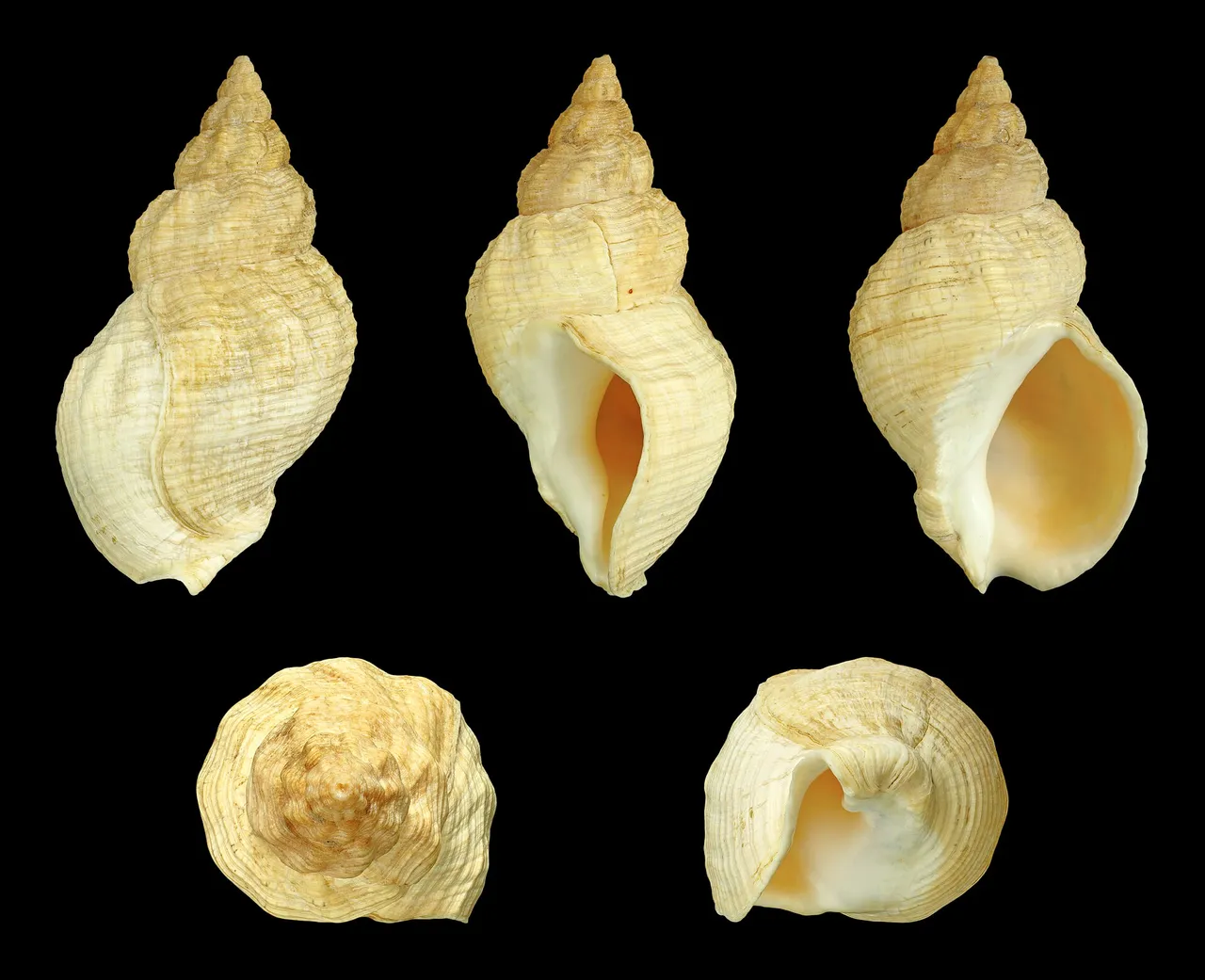
Identified by: Identified on shell sculpture and outline, which for a gastropod IS the identification: a fusiform shell with a tall spire, strong spiral cords crossed by broad axial undulations — the 'undatum' it is named for — a large ovate aperture with an orange interior, and a short siphonal canal with a distinct notch. Five studio views show every one. RECORDED AS AN EMPTY SHELL, which is what a gatherer will be holding.H. Zell — CC BY-SA 3.0, via Wikimedia Commons — source, licenceLook at this first
Find the groove. At the front of the shell opening, on the side away from the pointed tip, there is a distinct spout or channel — the animal pushes a siphon out through it to smell. Then check the size: this is a big snail, usually six to eight centimetres tall.
Diagnostic — settles it on its own
Each of these settles the identification on its own. If one is clear, you have your answer.
A spout at the front of the shell opening
Hold the shell with the opening facing you and the point upwards. At the bottom of the opening there is a definite channel or gutter running forward, unlike the smooth unbroken curve a periwinkle or a limpet shows. That channel houses an extendable siphon, which is a chemical sense organ: this animal finds carrion by smelling the water. The structure and the feeding mode go together, and the structure is readable on an empty shell.
Supporting — use with other characters
Real characters that are not conclusive by themselves. Use two or three together.
Size — six to eight centimetres tall, and heavy for it
Ordinary animals are six to eight centimetres in shell height, over ten is large, and shells around twelve centimetres are recorded in cold northern water. That places it well outside the range of every other British shore gastropod except the largest, and it is the quickest sorting test in the field. Note that growth rate and size at maturity vary substantially between grounds, so a small animal from a slow-growing ground may be mature and a similar-sized one elsewhere may not.
A thick chalky shell with pronounced spiral ridging
The shell is heavy in the hand, chalky white to pale brown, and carries strong spiral ridges crossed by growth lines, giving a sculptured surface rather than a smooth one. Compare with the dark, smooth, much lighter shell of a periwinkle. Worn and beach-rolled shells lose some of the sculpture and go whiter still, so weight and the front spout carry more than the surface does.
Which ground it came off, and how deep
This is a soft-ground animal: sand, mud and mixed bottoms from the low intertidal down to several hundred metres, with the fishery concentrated in shallower coastal water. It is not a rocky-shore animal. Something the same general shape picked off mid-shore rock is a dog whelk — much smaller, blunter, and a rocky-shore predator of barnacles and mussels — and the netted dog whelk of sandy ground is smaller again with a distinctly cross-hatched surface.
What it gets confused with
- Dog whelk, which shares the front spout and is very much smaller, blunter, and lives on rocky shores rather than soft ground. It is the commonest mistake and the animals are not remotely the same size once compared.
- Netted dog whelk of sandy ground, which is smaller again and carries a distinctive cross-hatched surface pattern rather than plain spiral ridging.
- Large common periwinkles, which are dark, smooth, much lighter in the hand and — decisively — carry no spout at the front of the aperture.
- Other large northern buccinids in the deeper part of the range, which share the general form and are separated on sculpture and proportion rather than on anything obvious.
Side by side: Common whelk vs Common periwinkle.
Where this stops working
Shell shape and sculpture vary considerably between grounds and with age, and beach-worn shells lose the surface detail that would help. Size is the least transferable character in this family: growth rate and size at maturity differ substantially between grounds, which is exactly why a single minimum landing size across a wide area is a poor fit and why the animal in your hand may be mature at a size that would be immature elsewhere. The great advantage remains that the front spout is structural and survives death, boiling and years on a strandline — but a boiled and shelled whelk on a plate cannot be identified at all, which is worth knowing before trusting a label.
The full record
This page covers identification only. The Common whelk record covers behaviour, lifecycle, distribution, handling and the sources behind all of it.
Reviewed 2026-08-16.
More about this fish
Telling it apart is one question. Here are the others.
Similar and related fish
How it is caught
Where it lives
Why the 3 connections on this page are here, and the sources
Similar and related fish
Backed by research — 1 connection
Supported by peer-reviewed research or fisheries science. The sources are listed and can be checked.
Common periwinkle
Two marine gastropods placed alongside one another because a reader meeting one will reasonably ask about the other, and because the distinction between them is a practical one about how each is taken.
- FishBase: a global information system on fishes — Froese, R. and D. Pauly, eds. — FishBase Consortium (Scientific institute)Relied on for: Distribution, habitat association and life history recorded for Buccinum undatum, Patella vulgata and Littorina littorea, including the rocky and soft-ground habitats each occupies.States this directlyPassage read and verified
- The IUCN Red List of Threatened Species — International Union for Conservation of Nature (Conservation authority)Relied on for: Assessment and range accounts for north-east Atlantic marine gastropods including Littorina littorea, and the habitats and pressures recorded for them.Background and mechanism onlyCitation checked — the work exists and is described correctly
How it is caught
What experienced anglers do — 1 connection
Widely and independently recommended by experienced anglers and specialist sources. This is real angling knowledge, not proof: controlled evidence for it is limited, and FishingHQ records it as convention rather than as a demonstrated effect.
Whelk potting
An established fishing practice for this species, recorded as the convention it is rather than as a tested claim.
- General angling website restatements of established technique — Various (Credible secondary source)Relied on for: Widely restated practice associating this discipline with this place, recorded as practitioner consensus rather than as tested fact.Background and mechanism onlyCitation checked — the work exists and is described correctly
- Fishers' Craft and Lettered Art: Tracts on Fishing from the End of the Middle Ages — University of Toronto Press, 1997 (Scientific literature)Relied on for: That fishing traditions develop around the water and fish available to them, and the historical method of reading such traditions.States this directlyCitation checked — the work exists and is described correctly
Where it lives
Backed by research — 1 connection
Supported by peer-reviewed research or fisheries science. The sources are listed and can be checked.
Inshore ground
A distribution association between an animal and a kind of water, rather than a claim about any named mark.
- FishBase: a global information system on fishes — Froese, R. and D. Pauly, eds. — FishBase Consortium (Scientific institute)Relied on for: Distribution, habitat association and depth range recorded for the species, including its occurrence in the water body concerned.States this directlyPassage read and verified
- The IUCN Red List of Threatened Species — International Union for Conservation of Nature (Conservation authority)Relied on for: Assessment and range account for the species, including the systems and coasts it occupies.Background and mechanism onlyCitation checked — the work exists and is described correctly
A claim that a place contains the ground and conditions the animal is associated with. It is a distributional statement about the world and rests on reference works, and it deliberately asserts nothing about access or permission.
- The Fishes of the British Isles and North-West Europe — Macmillan, 1969 (Reference work)Relied on for: Distribution and habitat association of the inshore fauna of the British Isles and the north-east Atlantic.States this directlyCitation checked — the work exists and is described correctly
- FishBase: a global information system on fishes — Froese, R. and D. Pauly, eds. — FishBase Consortium (Scientific institute)Relied on for: Recorded distribution and habitat association for the species where held.Background and mechanism onlyPassage read and verified
- The IUCN Red List of Threatened Species — International Union for Conservation of Nature (Conservation authority)Relied on for: Range and recorded threats for the species where assessed.Background and mechanism onlyCitation checked — the work exists and is described correctly
Safety
Boat safety — Can cause serious injury or death
Potting involves hauling strings of gear with rope running over a side or a hauler. A bight of rope round a limb as a string runs out, or gear hauled in a sea, is the mechanism behind a large share of small-boat fishing fatalities.
What reduces it: Keep clear of running rope and never stand inside a coil. Have a means of stopping the hauler within reach. Wear a lifejacket, work with a second person, and do not shoot or haul gear in conditions that put you on the deck.
Injury while handling fish — Minor injury
Whelk shells are thick, ridged and sharp at the aperture, and sorting catch by hand in quantity produces cuts that are slow to heal in seawater.
What reduces it: Gloves for sorting, and clean and dress any cut properly rather than letting a small wound in salt water become an infected one.