How to identify bonefish
Albula vulpes · Albulidae
The characters that identify bonefish, ranked by how far each one can be trusted on its own.
Safety: sun, dehydration and fatigue — can cause injury needing treatment. 2 more points apply here.
How this was identified, and who took it
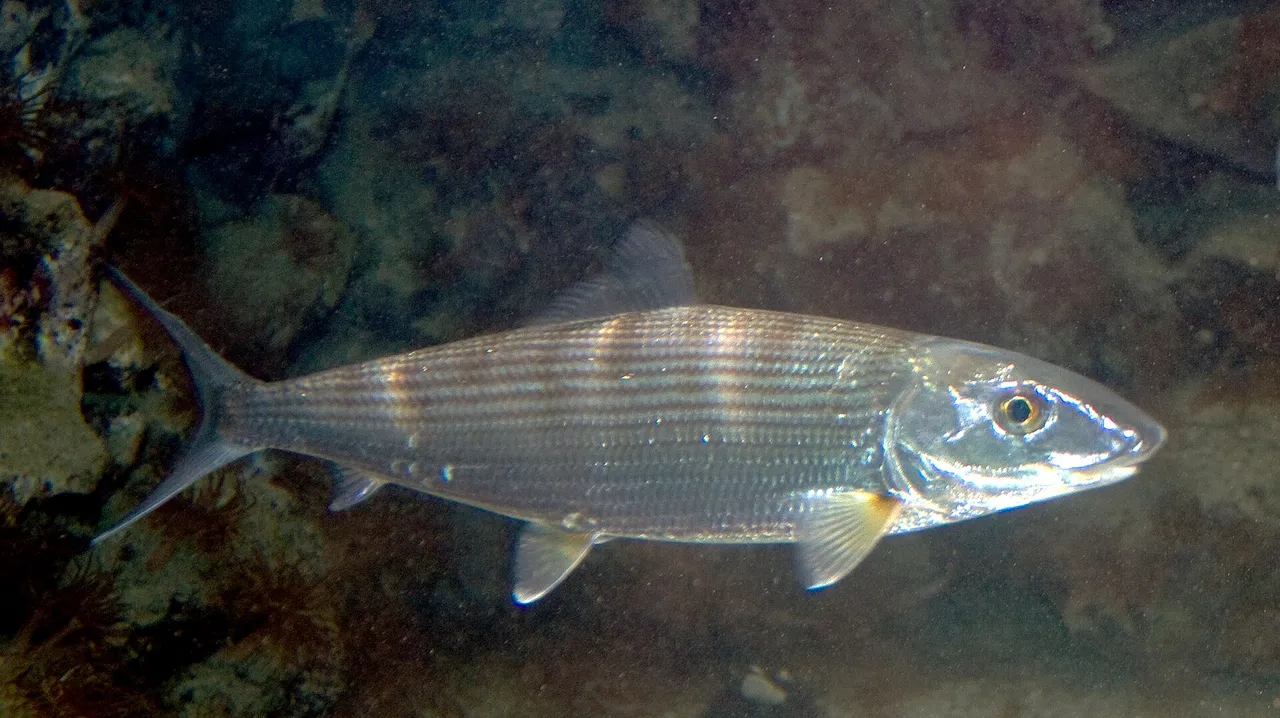
Identified by: Sharp, complete lateral view of a free-swimming fish. The conical pointed snout with a distinctly inferior mouth, the slender silver body with faint longitudinal striping, the single dorsal fin and the deeply forked tail together identify the species, and the head shape in particular separates it from the mullets it is superficially similar to at a distance.Brian Gratwicke — CC BY 2.0, via Wikimedia Commons — source, licenceLook at this first
A pointed snout hanging over a mouth that opens underneath it, on a body shaped like a rifle round. That combination — the overshot conical nose and the low mouth — is what a fish built to root through sand looks like, and nothing else on a flat is built that way.
Diagnostic — settles it on its own
Each of these settles the identification on its own. If one is clear, you have your answer.
A conical snout overhanging an inferior mouth
The snout projects forward past the jaw and the mouth opens below it, small and unarmed. It is the whole feeding apparatus of the species and it separates a bonefish from every jack, mullet and permit on the same water.
Supporting — use with other characters
Real characters that are not conclusive by themselves. Use two or three together.
No spines anywhere, and no adipose fin
All fins are soft-rayed and there is no small fleshy fin behind the dorsal. Between them these two absences rule out the salmonids and most of the spiny-rayed fish that might otherwise be considered.
A single mid-body dorsal on a cylindrical body
One dorsal fin set around the middle of a round, streamlined body with a deeply forked tail. The outline is distinctive enough to name a fish from a silhouette against pale sand.
Suggestive only — varies with condition
Hints only. These vary with condition, season, water and how long the fish has been out of it, and a fish that contradicts them is still the same species.
Tailing and mudding
On a flat you usually see the behaviour before the fish: a tail tip breaking the surface as the fish feeds head-down, or a plume of stirred sediment moving across clean sand. It is how these fish are found, and it identifies a feeding fish rather than a species.
What it gets confused with
- Ladyfish, which is silver and slender but has a terminal upturned mouth rather than an overhung one.
- Mullet on the same flats, separated by the blunt head and the very different mouth.
- Other Albula species, which are the genuine difficulty and are not separable in the field at all.
Side by side: Bonefish vs Atlantic tarpon.
Where this stops working
The bonefishes have been substantially revised and populations once treated as a single widespread species are now recognised as several, some of which occur together on the same flats. No field character distinguishes them; the work is genetic. A page can identify a fish as a bonefish with confidence and cannot always say which one, and that is an honest limit rather than an evasion.
The full record
This page covers identification only. The Bonefish record covers behaviour, lifecycle, distribution, handling and the sources behind all of it.
Reviewed 2026-08-14.
More about this fish
Telling it apart is one question. Here are the others.
Similar and related fish
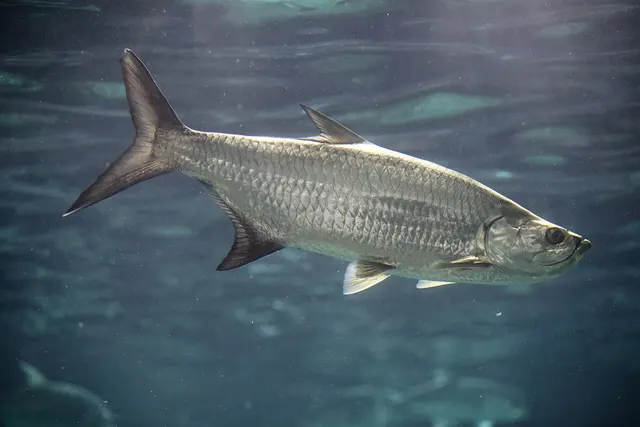 Atlantic tarponBoth produce transparent ribbon-like leptocephalus larvae that drift in the plankton before metamorphosing — a developmental route shared with eels and with almost nothing else an angler meets.
- Roundjaw bonefishThe Indo-Pacific bonefish and the Caribbean one, and almost all the writing is about the second.
How it is caught
Where it lives
Where you will find it
- CubaOn the flats of the offshore cays, in numbers and average size that reflect decades of low fishing pressure as much as they reflect the habitat.
- FloridaFeeds over shallow sand and marl flats, principally in the Keys, and is the species the state's sight-fishing discipline was built around.
- The Egyptian Red Sea coastOn the sand and seagrass flats of sheltered bays, which is the nursery ground this riverless coast has instead of estuaries.
- The Yucatán and Mexican Caribbean coastOn hundreds of square kilometres of white carbonate sand flat, in the numbers that made this coast a flats destination in the first place.
Why the 8 connections on this page are here, and the sources
Similar and related fish
Backed by research — 2 connections
Supported by peer-reviewed research or fisheries science. The sources are listed and can be checked.
Atlantic tarpon
A developmental-biology claim that links two flagship flats species through something a reader would never guess from looking at them.
- FishBase: a global information system on fishes — Froese, R. and D. Pauly, eds. — FishBase Consortium (Scientific institute)Relied on for: That transparent leptocephalus larvae of Megalops atlanticus migrate into estuaries, and that Albula vulpes has a leptocephalus larval stage.States this directlyPassage read and verified
Roundjaw bonefish
Albula glossodonta has a rounded lower jaw, reaches 90 cm and 8.6 kg, and ranges from the Red Sea to Hawaii and the Tuamotus; Albula vulpes is the western Atlantic species that the great majority of English-language bonefishing literature describes. The Indo-Pacific fish is assessed Vulnerable and the Atlantic one is assessed separately.
- FishBase: a global information system on fishes — Froese, R. and D. Pauly, eds. — FishBase Consortium (Scientific institute)Relied on for: The morphology, size, depth range and distribution that separate these two species from one another.States this directlyPassage read and verified
How it is caught
What experienced anglers do — 1 connection
Widely and independently recommended by experienced anglers and specialist sources. This is real angling knowledge, not proof: controlled evidence for it is limited, and FishingHQ records it as convention rather than as a demonstrated effect.
Saltwater fly fishing
A practitioner claim about the defining method for the species.
- IGFA International Angling Rules and World Record Requirements — International Game Fish Association (Angling or fisheries organisation)Relied on for: Fly tackle classes and their use in saltwater angling.Passage read and verified
- Trout & Salmon — Bauer Media (Specialist angling publication)Relied on for: Contemporary treatment of saltwater flats fly fishing.Citation checked — the work exists and is described correctly
A statement about how a species is fished, which is angling convention rather than biology and is labelled as such.
- Still Water Fly-Fishing — Andre Deutsch, 1952 (Specialist angling publication)Relied on for: Fly-fishing practice from a practitioner tradition: line control, depth management, retrieve and the reading of water.States this directlyCitation checked — the work exists and is described correctly
- Sea Angler — Bauer Media (Specialist angling publication)Relied on for: Contemporary UK sea angling practice as reported by practitioners: ground, tackle, presentation and seasonal timing.States this directlyCitation checked — the work exists and is described correctly
A practitioner claim about the defining application of the method.
- IGFA International Angling Rules and World Record Requirements — International Game Fish Association (Angling or fisheries organisation)Relied on for: Fly tackle classes and their use in saltwater angling.Passage read and verified
- Trout & Salmon — Bauer Media (Specialist angling publication)Relied on for: Contemporary treatment of saltwater fly technique in the angling press.Citation checked — the work exists and is described correctly
Where it lives
Backed by research — 1 connection
Supported by peer-reviewed research or fisheries science. The sources are listed and can be checked.
Seagrass beds
A habitat association resting on the regional identification and fisheries literature rather than on angling report.
- JNCC species and habitat conservation advice — Joint Nature Conservation Committee (Conservation authority)Relied on for: UK and European habitat classification and the conservation status of seagrass beds, including the species associated with them.States this directlyCitation checked — the work exists and is described correctly
- FAO Species Identification Guides for Fishery Purposes and the FAO Species Catalogues — Food and Agriculture Organization of the United Nations (Scientific institute)Relied on for: Habitat association and distribution of the species concerned.States this directlyCitation checked — the work exists and is described correctly
Where you will find it
Backed by research — 4 connections
Supported by peer-reviewed research or fisheries science. The sources are listed and can be checked.
Cuba
That a species occurs in these waters, drawn from distribution science. It is a statement about where the animal lives and is not a statement that anybody will catch one, still less where.
- FAO Species Identification Guides for Fishery Purposes and the FAO Species Catalogues — Food and Agriculture Organization of the United Nations (Scientific institute)Relied on for: Identification, distribution and habitat association of the fishes and invertebrates of the tropical region named.States this directlyCitation checked — the work exists and is described correctly
- FishBase: a global information system on fishes — Froese, R. and D. Pauly, eds. — FishBase Consortium (Scientific institute)Relied on for: Recorded distribution, depth range and habitat association of the species named, including its occurrence in the waters concerned.States this directlyPassage read and verified
Florida
A distribution association between an animal and a kind of water, rather than a claim about any named mark.
- NOAA National Ocean Service education on estuaries and the National Estuarine Research Reserve System — National Oceanic and Atmospheric Administration, United States (Government fisheries body)Relied on for: Estuarine, seagrass and coastal habitat function in North American waters, and the nursery role of shallow habitat for the species concerned.Background and mechanism onlyCitation checked — the work exists and is described correctly
- FishBase: a global information system on fishes — Froese, R. and D. Pauly, eds. — FishBase Consortium (Scientific institute)Relied on for: Distribution, habitat association, depth range and life history recorded for the species.States this directlyPassage read and verified
The Egyptian Red Sea coast
A distributional claim about where a species occurs, resting on the regional identification literature rather than on angling report. It says nothing about where a reader should fish.
- FAO Species Identification Guides for Fishery Purposes and the FAO Species Catalogues — Food and Agriculture Organization of the United Nations (Scientific institute)Relied on for: Species composition, habitat association and distribution for the region concerned, as set out in the FAO species identification sheets.States this directlyCitation checked — the work exists and is described correctly
- The IUCN Red List of Threatened Species — International Union for Conservation of Nature (Conservation authority)Relied on for: Global assessment and distribution for the species concerned.States this directlyCitation checked — the work exists and is described correctly
The Yucatán and Mexican Caribbean coast
That a species occurs in these waters, drawn from distribution science. It is a statement about where the animal lives and is not a statement that anybody will catch one, still less where.
- FAO Species Identification Guides for Fishery Purposes and the FAO Species Catalogues — Food and Agriculture Organization of the United Nations (Scientific institute)Relied on for: Identification, distribution and habitat association of the fishes and invertebrates of the tropical region named.States this directlyCitation checked — the work exists and is described correctly
- FishBase: a global information system on fishes — Froese, R. and D. Pauly, eds. — FishBase Consortium (Scientific institute)Relied on for: Recorded distribution, depth range and habitat association of the species named, including its occurrence in the waters concerned.States this directlyPassage read and verified
Safety
Sun, dehydration and fatigue — Can cause injury needing treatment
Flats fishing means long hours in shallow tropical water with sun overhead and reflected off both the water and pale sand. Sunburn is worse than expected and dehydration builds unnoticed while concentrating.
What reduces it: Cover up rather than relying on sunscreen, wear polarised glasses — needed to see fish in any case — and drink steadily rather than when thirsty.
Encounters with marine life — Can cause injury needing treatment
Flats hold stingrays resting in the sand, and a wading angler who steps on one may be barbed in the lower leg or foot. Sharks and barracuda follow hooked and exhausted fish, sometimes to the angler's feet.
What reduces it: Shuffle rather than step when wading soft ground, which moves rays away instead of onto. Wear wading boots. Do not hold an exhausted fish beside you if predators are working the flat.
Tides and being cut off — Can cause injury needing treatment
Flats are fishable because they flood and drain. An angler who has waded out on a falling tide and is concentrating on fish may find the return crossing has become deep on the flood.
What reduces it: Know the tide before wading, identify the route back, and leave on a set time rather than on how the fishing is going.