How to identify australian bass
Macquaria novemaculeata · Percalatidae
The characters that identify australian bass, ranked by how far each one can be trusted on its own.
Safety: venomous and spined species — can cause injury needing treatment. One more point applies here.
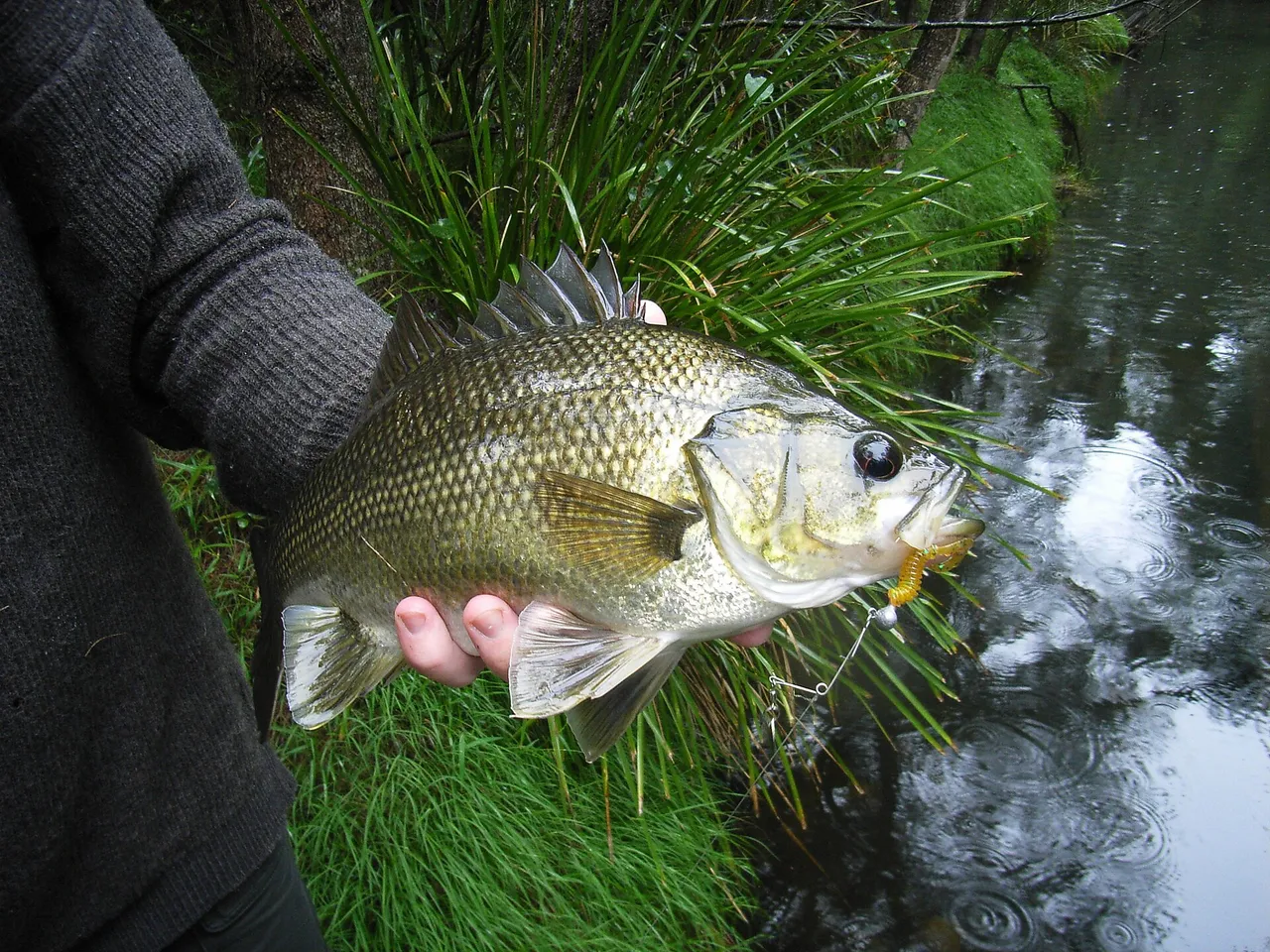
How this was identified, and who took it
Identified by: Full lateral view of a fresh fish. The head profile runs straight to slightly convex from the snout to the dorsal origin rather than dipping inward, which is the character separating Australian bass from estuary perch — the one confusion that matters for this species — and the freshwater setting the contributor records supports it. Spiny dorsal, rounded anal and caudal fins and the whole body outline are legible.Codman at en.wikipedia, CC BY-SA 3.0, via Wikimedia Commons — source, licenceLook at this first
Run your eye along the top of the head from the snout to where the dorsal fin starts. On an Australian bass that line is straight or slightly rounded. On an estuary perch — the fish it shares rivers with and is constantly taken for — it dips inward above the eye.
No single character settles this one. Everything below is supporting or suggestive, and a confident identification needs several of them together — or, for the hardest cases, a count that cannot be made from a photograph.
Supporting — use with other characters
Real characters that are not conclusive by themselves. Use two or three together.
A head profile that does not dip
Straight to gently convex from snout to dorsal origin. Estuary perch is distinctly concave along the same line. It is the best character available for a pair that is otherwise very close, and it is why this page ranks it first despite being a judgement rather than a count.
A deeply notched dorsal fin
The dorsal is divided almost through between its spiny and soft halves. Shared with estuary perch, so it places the fish rather than naming it — but it separates both from the introduced redfin and from the native grunters.
A small mouth reaching about to the eye
The jaw ends roughly beneath the front or middle of the eye rather than past it. Modest for the body size and useful in combination with the head profile, since estuary perch tends to a slightly larger mouth on a longer head.
Which water it came out of
Adults hold in the fresh reaches of coastal rivers and drop to the estuary to spawn, while estuary perch sits lower in the system for more of the year. Overlap is real and considerable, so this narrows rather than decides.
Suggestive only — varies with condition
Hints only. These vary with condition, season, water and how long the fish has been out of it, and a fish that contradicts them is still the same species.
Bronze-olive colouring
Handsome, and no help. Fish from tannin-stained coastal streams are dark bronze and fish from clear impoundments are much paler, and estuary perch does the same thing in the same waters.
What it gets confused with
- Estuary perch, which is the entire difficulty and shares much of the range.
- Redfin perch where introduced, separated at once by two clearly separate dorsal fins and bold vertical barring.
- Stocked impoundment fish above barriers, where a population exists only because it was put there and range tells you nothing.
Side by side: Australian bass vs Estuary perch.
Where this stops working
This page has no diagnostic character, and that is a statement about the species pair rather than about the writing: Australian bass and estuary perch are separated in the field on a head profile that varies between individuals, and hybrids between them occur naturally where their ranges meet. Stocking has put bass above barriers they could never have passed, so distribution has become a weaker guide than it was. Where a size or bag rule distinguishes the two, a fish that cannot be confidently separated should be treated as the more restricted one.
The full record
This page covers identification only. The Australian bass record covers behaviour, lifecycle, distribution, handling and the sources behind all of it.
Reviewed 2026-08-14.
More about this fish
Telling it apart is one question. Here are the others.
Similar and related fish
How it is caught
Where it lives
Why the 3 connections on this page are here, and the sources
Similar and related fish
Backed by research — 1 connection
Supported by peer-reviewed research or fisheries science. The sources are listed and can be checked.
Estuary perch
An identification comparison naming both binomials: Percalates colonorum and Macquaria novemaculeata.
- FishBase: a global information system on fishes — Froese, R. and D. Pauly, eds. — FishBase Consortium (Scientific institute)Relied on for: Morphological and distributional data for Percalates colonorum and for Macquaria novemaculeata.States this directlyPassage read and verified
- The IUCN Red List of Threatened Species — International Union for Conservation of Nature (Conservation authority)Relied on for: Separate assessments treating Percalates colonorum and Macquaria novemaculeata as distinct species.States this directlyCitation checked — the work exists and is described correctly
How it is caught
What experienced anglers do — 1 connection
Widely and independently recommended by experienced anglers and specialist sources. This is real angling knowledge, not proof: controlled evidence for it is limited, and FishingHQ records it as convention rather than as a demonstrated effect.
Spinning
Established angling practice for this species, recorded as convention. The note states the property of the animal or its water that makes the method the answer.
- IGFA International Angling Rules and World Record Requirements — International Game Fish Association (Angling or fisheries organisation)Relied on for: Recognition of the species as an established sport fish and the angling methods and tackle classes conventionally used for it.States this directlyPassage read and verified
- General angling website restatements of established technique — Various (Credible secondary source)Relied on for: Widely restated practice connecting this species and method.Background and mechanism onlyCitation checked — the work exists and is described correctly
Where it lives
Backed by research — 1 connection
Supported by peer-reviewed research or fisheries science. The sources are listed and can be checked.
Estuary
A life-history claim with direct management consequence, held to a scientific standard.
- FishBase: a global information system on fishes — Froese, R. and D. Pauly, eds. — FishBase Consortium (Scientific institute)Relied on for: That Macquaria novemaculeata occupies coastal rivers and estuaries of eastern Australia with a catadromous life history.States this directlyPassage read and verified
- NASCO conservation and management of North Atlantic salmon — North Atlantic Salmon Conservation Organization (Government fisheries body)Relied on for: That diadromous fish depend on unobstructed passage between fresh and salt water and that barriers are a recognised management concern.FishingHQ's interpretation of what it saysCitation checked — the work exists and is described correctly
Safety
Venomous and spined species — Can cause injury needing treatment
Sharp dorsal spines and firm gill covers on a fish handled in the dark from a boat or bank, which is when most of the fishing happens.
What reduces it: Wet hands, support the body, keep fingers clear of the gill plates, and carry a light. Use long pliers rather than fingers for unhooking treble-hooked lures.
Hooks and barbs — Can cause injury needing treatment
Surface and hard-bodied lures carrying treble hooks, on a thrashing fish landed at night around heavy structure.
What reduces it: Control the fish before unhooking, use a de-hooking tool, and carry a good light. Cut the line rather than pulling at a hook that is in past the barb.