How to identify golden mahseer
Tor putitora · Cyprinidae
The characters that identify golden mahseer, ranked by how far each one can be trusted on its own.
Safety: moving water and currents — can cause serious injury or death. One more point applies here.
How this was identified, and who took it
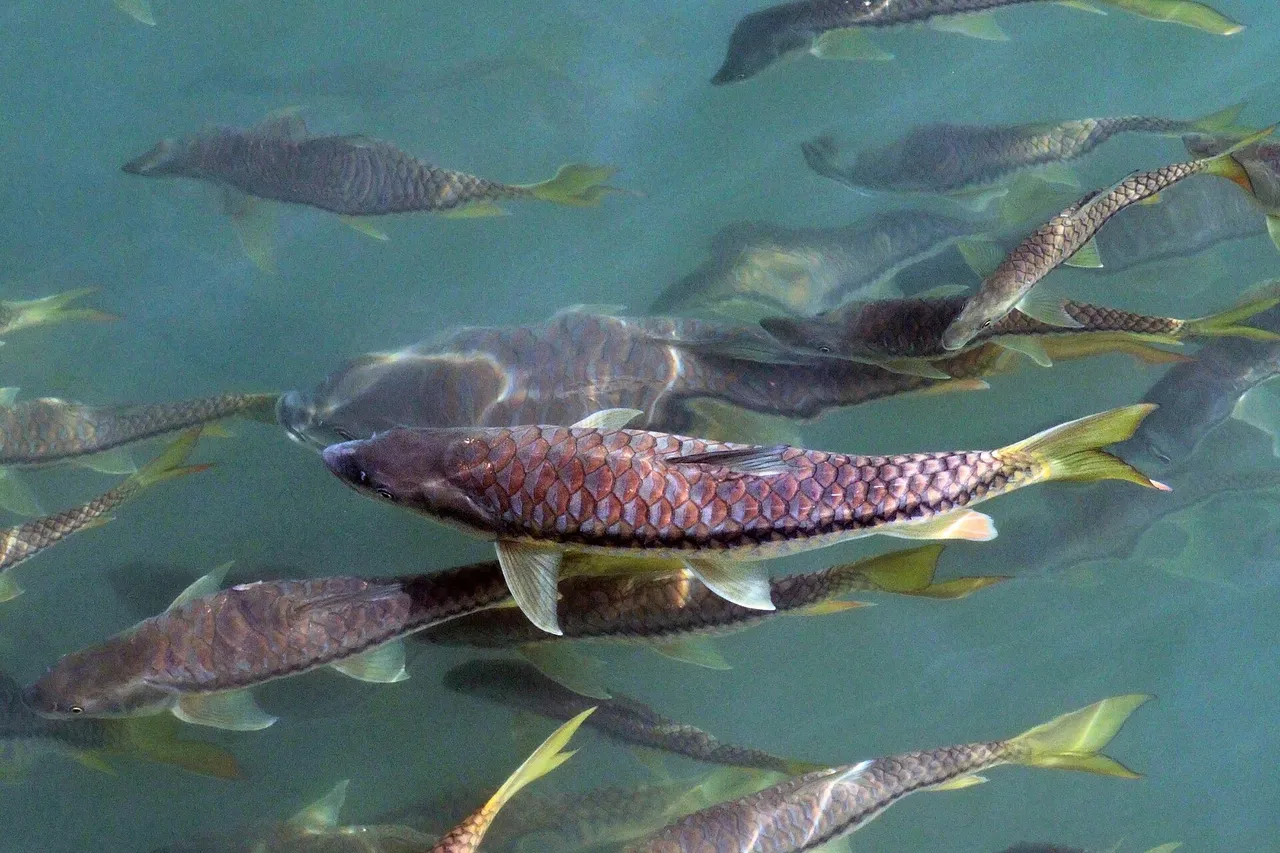
Identified by: A wild shoal in clear river water with one fish in near-full lateral view. The enormous scales that define a mahseer are unmistakable, along with the thick lips, golden-olive flank and yellow-tinged forked tail. All fish in frame are the same species.Charles J. Sharp — CC BY-SA 4.0, via Wikimedia Commons — source, licenceLook at this first
Scales first: very large, each one strongly outlined, giving the flank the look of overlapping plates. Then the mouth — thick fleshy lips set underneath the snout with two pairs of barbels. That is a mahseer, and the species question comes after.
No single character settles this one. Everything below is supporting or suggestive, and a confident identification needs several of them together — or, for the hardest cases, a count that cannot be made from a photograph.
Supporting — use with other characters
Real characters that are not conclusive by themselves. Use two or three together.
Very large, strongly outlined scales
Individual scales are big enough to count across the flank and each is edged distinctly, which is what gives mahseer their armoured appearance. It identifies the group immediately among the large Asian cyprinids.
Thick lips under an inferior mouth, with two barbel pairs
The mouth sits beneath the snout with heavy fleshy lips and four barbels in total. It is a bottom feeder's apparatus built for holding station in current, and lip structure is one of the characters used to separate the Tor from one another.
A deeply forked tail on a streamlined body
Powerfully built and cleanly tapered with a strongly forked tail, quite unlike the deep-bodied carps that share some of the same rivers. It is the shape of a fish that lives in fast water.
Where in the river the fish was
Rocky rapid streams and the pools below them, across the Himalayan drainages from Afghanistan to Myanmar. Habitat narrows the possibilities in a region where the large cyprinid fauna is otherwise substantial.
Suggestive only — varies with condition
Hints only. These vary with condition, season, water and how long the fish has been out of it, and a fish that contradicts them is still the same species.
Brassy flanks and orange fins
The colouring behind the common name and the least reliable thing here. It varies between river systems and with the season, and other Tor do the same thing.
What it gets confused with
- Other Tor species across South Asia, which is the genuine difficulty and is not resolvable by eye.
- Neolissochilus and Naziritor, related genera in the same rivers with similar scaling.
- Large common carp where introduced, separated by the very different lip structure and dorsal fin.
Where this stops working
The mahseers are a taxonomically unsettled group and several Tor overlap in range and appearance, separated on scale counts, lip lobe structure and barbel proportion rather than on anything a photograph shows. This page can identify a fish as a mahseer confidently and cannot always say which one. The species is assessed as Endangered, which means handling technique in fast water is doing conservation work rather than being a courtesy.
The full record
This page covers identification only. The Golden mahseer record covers behaviour, lifecycle, distribution, handling and the sources behind all of it.
Reviewed 2026-08-14.
More about this fish
Telling it apart is one question. Here are the others.
Similar and related fish
How it is caught
- LedgeringStatic bottom baits in deep pools take mahseer holding out of the main current, and this is the traditional method of the Indian river fishery.
- SpinningHeavy spoons swung across fast Himalayan currents are the classic mahseer approach, and the weight is a response to the flow rather than to the fish.
Where it lives
Where you will find it
Why the 5 connections on this page are here, and the sources
Similar and related fish
Backed by research — 1 connection
Supported by peer-reviewed research or fisheries science. The sources are listed and can be checked.
Deccan mahseer
An identification comparison naming both binomials: Tor khudree and Tor putitora.
- FishBase: a global information system on fishes — Froese, R. and D. Pauly, eds. — FishBase Consortium (Scientific institute)Relied on for: Morphological and distributional data for Tor khudree and for Tor putitora.States this directlyPassage read and verified
- The IUCN Red List of Threatened Species — International Union for Conservation of Nature (Conservation authority)Relied on for: Separate assessments treating Tor khudree and Tor putitora as distinct species.States this directlyCitation checked — the work exists and is described correctly
How it is caught
What experienced anglers do — 2 connections
Widely and independently recommended by experienced anglers and specialist sources. This is real angling knowledge, not proof: controlled evidence for it is limited, and FishingHQ records it as convention rather than as a demonstrated effect.
Ledgering
Established angling practice for this species, recorded as convention. The note states the property of the animal or its water that makes the method the answer.
- IGFA International Angling Rules and World Record Requirements — International Game Fish Association (Angling or fisheries organisation)Relied on for: Recognition of the species as an established sport fish and the angling methods and tackle classes conventionally used for it.States this directlyPassage read and verified
- General angling website restatements of established technique — Various (Credible secondary source)Relied on for: Widely restated practice connecting this species and method.Background and mechanism onlyCitation checked — the work exists and is described correctly
Spinning
Established angling practice for this species, recorded as convention. The note states the property of the animal or its water that makes the method the answer.
- IGFA International Angling Rules and World Record Requirements — International Game Fish Association (Angling or fisheries organisation)Relied on for: Recognition of the species as an established sport fish and the angling methods and tackle classes conventionally used for it.States this directlyPassage read and verified
- General angling website restatements of established technique — Various (Credible secondary source)Relied on for: Widely restated practice connecting this species and method.Background and mechanism onlyCitation checked — the work exists and is described correctly
Where it lives
Backed by research — 1 connection
Supported by peer-reviewed research or fisheries science. The sources are listed and can be checked.
Lowland rivers
A habitat and life-history claim held to a scientific standard.
- FishBase: a global information system on fishes — Froese, R. and D. Pauly, eds. — FishBase Consortium (Scientific institute)Relied on for: That Tor putitora inhabits streams, riverine pools and lakes including rapid streams with rocky bottoms, and is potamodromous, migrating from lower to middle reaches for spawning during low-flood phases.States this directlyPassage read and verified
Where you will find it
Backed by research — 1 connection
Supported by peer-reviewed research or fisheries science. The sources are listed and can be checked.
The Himalayan mahseer rivers
A distribution association between an animal and a kind of water, rather than a claim about any named mark.
- The IUCN Red List of Threatened Species — International Union for Conservation of Nature (Conservation authority)Relied on for: Assessment and habitat account for the species, including the river or lake system it occupies and the pressures acting on it.States this directlyCitation checked — the work exists and is described correctly
- FishBase: a global information system on fishes — Froese, R. and D. Pauly, eds. — FishBase Consortium (Scientific institute)Relied on for: Distribution, habitat association, size and life history recorded for the species in the system concerned.States this directlyPassage read and verified
Safety
Moving water and currents — Can cause serious injury or death
This is fishing in fast Himalayan rivers with rocky beds, strong flow and rapidly changing levels. Wading is genuinely dangerous and rivers rise fast with rainfall in the catchment rather than overhead.
What reduces it: Do not wade fast rocky water alone. Use a wading staff, check the forecast for the catchment, and be willing to walk round rather than cross. Wear a buoyancy aid where flow is significant.
Injury while handling fish — Minor injury
A large, heavy, powerful fish with hard scales and strong fins, handled in current.
What reduces it: Support the body horizontally with wet hands and work in the water rather than lifting the fish out.