How to identify bull trout
Salvelinus confluentus · Salmonidae
The characters that identify bull trout, ranked by how far each one can be trusted on its own.
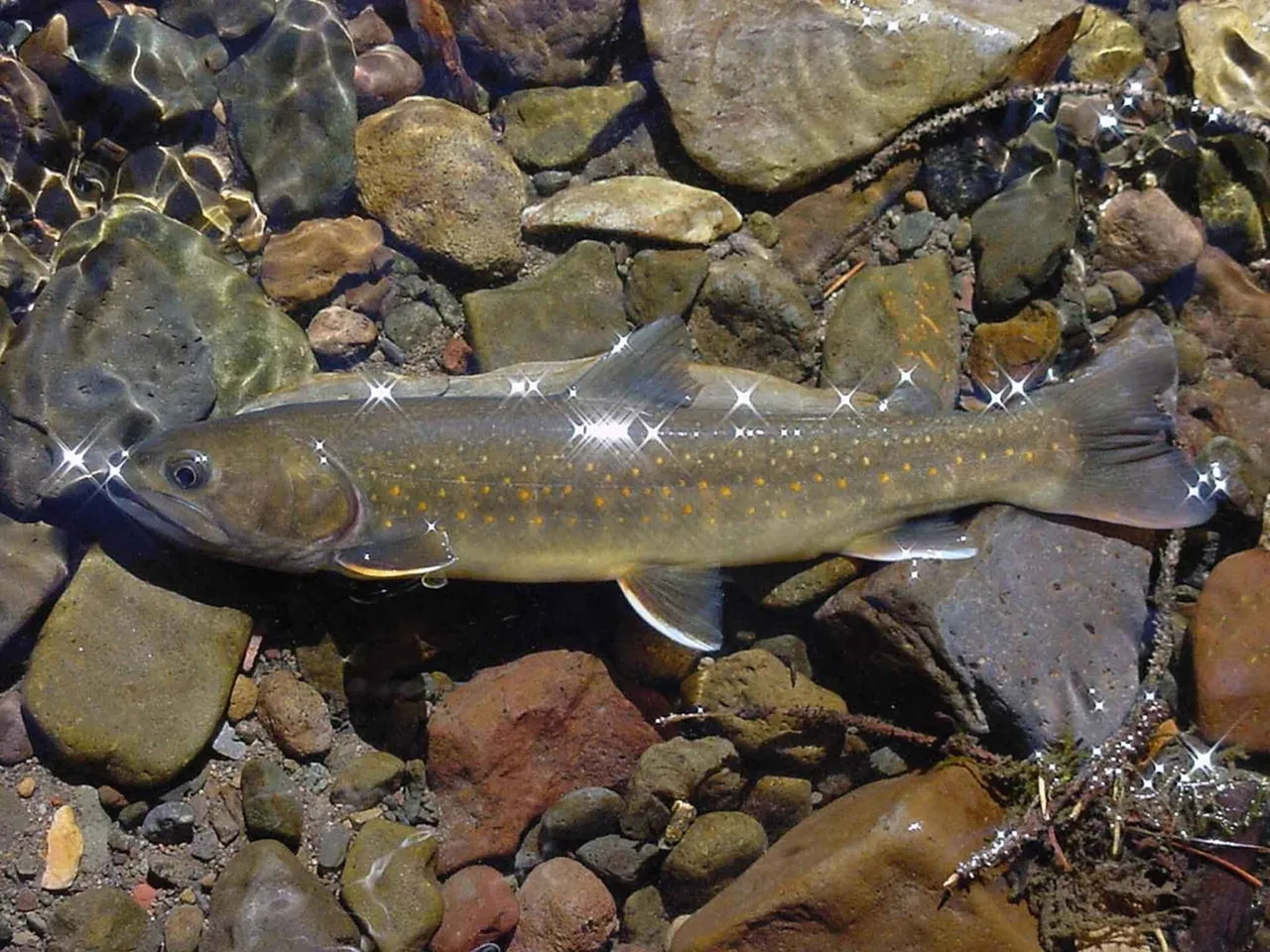
How this was identified, and who took it
Identified by: Identified on absences as much as presences, which is what 'no black, put it back' encodes. The back carries NO vermiculations, the flank carries pale cream and orange spots and NO black spots, and the dorsal fin is plain rather than barred as in Salvelinus fontinalis. White leading edges on the pelvic and anal fins place it among the chars. The dorsal is in frame, which is why this beat a sharper head portrait that crops it off.Bart Gammet, U.S. Fish and Wildlife Service — public domain, via Wikimedia Commons — source, licenceLook at this first
Look at the dorsal fin. A bull trout's is plain and unmarked; a brook trout's carries strong dark barring, on any fish in any condition. The field rule across the north-west is 'no black, put it back', and the dorsal fin is where it can actually be checked.
Diagnostic — settles it on its own
Each of these settles the identification on its own. If one is clear, you have your answer.
A plain dorsal fin
The dorsal fin is unmarked. A brook trout's dorsal carries strong dark barring or vermiculation, and it is visible on any fish in any condition. This is the single most useful check and it is the reason a photograph that crops the dorsal fin cannot identify one of these fish.
Supporting — use with other characters
Real characters that are not conclusive by themselves. Use two or three together.
Pale spots on a darker ground, and no dark spots
The flank carries pale spots — cream, yellow or orange-pink — on an olive to grey-brown ground. The tonal polarity is the structural part and holds in any light: PALE marks on a DARKER body. The additional claim that no spot is black is a hue claim, it is the half of the field rule most affected by water colour and condition, and it is recorded as supporting for that reason. A brook trout carries pale spots too, plus red spots ringed with blue and vermiculations on the back.
No vermiculations on the back
The back is plain or faintly mottled. A brook trout has distinct wormlike pale markings across the back and dorsal, which is where its old name of 'squaretail' company came from. Bull trout do not.
A broad flat head and a large mouth
The head is noticeably broad and flattened between the eyes — the source of the name — and the upper jaw extends back past the rear of the eye in an adult. Dolly Varden, the closest relative, is more slender-headed, but the two overlap and this is a supporting character rather than a decisive one.
White leading edges on the lower fins
The pelvic and anal fins carry a clean white front edge with a dark line behind it. This places the fish among the chars — Salvelinus — rather than the trouts, and is shared with brook trout and Dolly Varden. Useful for narrowing the group, useless for separating within it.
What it gets confused with
- Brook trout, constantly, and the confusion runs in the dangerous direction. Check the dorsal fin: barred means brook trout, plain means bull trout.
- Dolly Varden, which is genuinely difficult and in places genuinely impossible by eye. Where the two overlap, treat any char as a bull trout for the purposes of what you do next.
- Lake trout, which has a deeply forked tail and pale spotting over a darker ground.
- Brook trout hybrids, which occur where brook trout have been introduced and which show intermediate marking.
Side by side: Bull trout vs Brook trout.
Where this stops working
Dolly Varden and bull trout cannot reliably be separated in the field where their ranges meet, and hybrids with introduced brook trout are intermediate in exactly the characters used above. This is a species where an uncertain identification has a consequence rather than just an embarrassment: bull trout are protected across much of the United States portion of their range, many populations may not be fished for at all, and where fishing is permitted it is frequently release-only. The correct response to an uncertain char in bull trout water is to return it in the water without lifting it, and to check the rules for that specific watershed before fishing there at all.
The full record
This page covers identification only. The Bull trout record covers behaviour, lifecycle, distribution, handling and the sources behind all of it.
Reviewed 2026-08-15.
More about this fish
Telling it apart is one question. Here are the others.
Similar and related fish
How it is caught
Where it lives
Why the 4 connections on this page are here, and the sources
Similar and related fish
Backed by research — 1 connection
Supported by peer-reviewed research or fisheries science. The sources are listed and can be checked.
Brook trout
An identification comparison naming both binomials: Salvelinus confluentus and Salvelinus fontinalis.
- FishBase: a global information system on fishes — Froese, R. and D. Pauly, eds. — FishBase Consortium (Scientific institute)Relied on for: Morphological and distributional data for Salvelinus confluentus and for Salvelinus fontinalis.States this directlyPassage read and verified
- The IUCN Red List of Threatened Species — International Union for Conservation of Nature (Conservation authority)Relied on for: Separate assessments treating Salvelinus confluentus and Salvelinus fontinalis as distinct species.States this directlyCitation checked — the work exists and is described correctly
How it is caught
What experienced anglers do — 2 connections
Widely and independently recommended by experienced anglers and specialist sources. This is real angling knowledge, not proof: controlled evidence for it is limited, and FishingHQ records it as convention rather than as a demonstrated effect.
Spinning
A practitioner claim about how Salvelinus confluentus is commonly fished, following from where and how it feeds.
- General angling website restatements of established technique — Various (Credible secondary source)Relied on for: Widely restated practitioner accounts of fishing for bull trout.Citation checked — the work exists and is described correctly
- Sea Angler — Bauer Media (Specialist angling publication)Relied on for: Practitioner treatment of the methods used for bull trout and comparable species.Citation checked — the work exists and is described correctly
Stillwater fly fishing
A practitioner claim about how Salvelinus confluentus is commonly fished, following from where and how it feeds.
- General angling website restatements of established technique — Various (Credible secondary source)Relied on for: Widely restated practitioner accounts of fishing for bull trout.Citation checked — the work exists and is described correctly
- Sea Angler — Bauer Media (Specialist angling publication)Relied on for: Practitioner treatment of the methods used for bull trout and comparable species.Citation checked — the work exists and is described correctly
Where it lives
Backed by research — 1 connection
Supported by peer-reviewed research or fisheries science. The sources are listed and can be checked.
Lowland rivers
A habitat association for Salvelinus confluentus taken from the environment and distribution data on its FishBase summary.
- FishBase: a global information system on fishes — Froese, R. and D. Pauly, eds. — FishBase Consortium (Scientific institute)Relied on for: The environment, depth range and habitat description recorded for Salvelinus confluentus.States this directlyPassage read and verified