European sea urchin
Fish · Last reviewed 2026-08-12
A spined grazer of shallow Mediterranean and Atlantic rock whose gonads are a delicacy, collected by hand and by free-diving, and depleted across much of its range by exactly that.
Safety: shallow water blackout and breath-hold loss of consciousness — can cause serious injury or death. 6 more points apply here.
Shallow water blackout and breath-hold loss of consciousness — Can cause serious injury or death
Collection by free-diving puts a diver on the bottom working with both hands on a stationary target, which lengthens dives and removes attention from breath-hold state.
What reduces it: Get proper freediving instruction. Dive with a competent buddy on one-up-one-down, never alone. The animal is not going anywhere — surface rather than extending a dive for it.
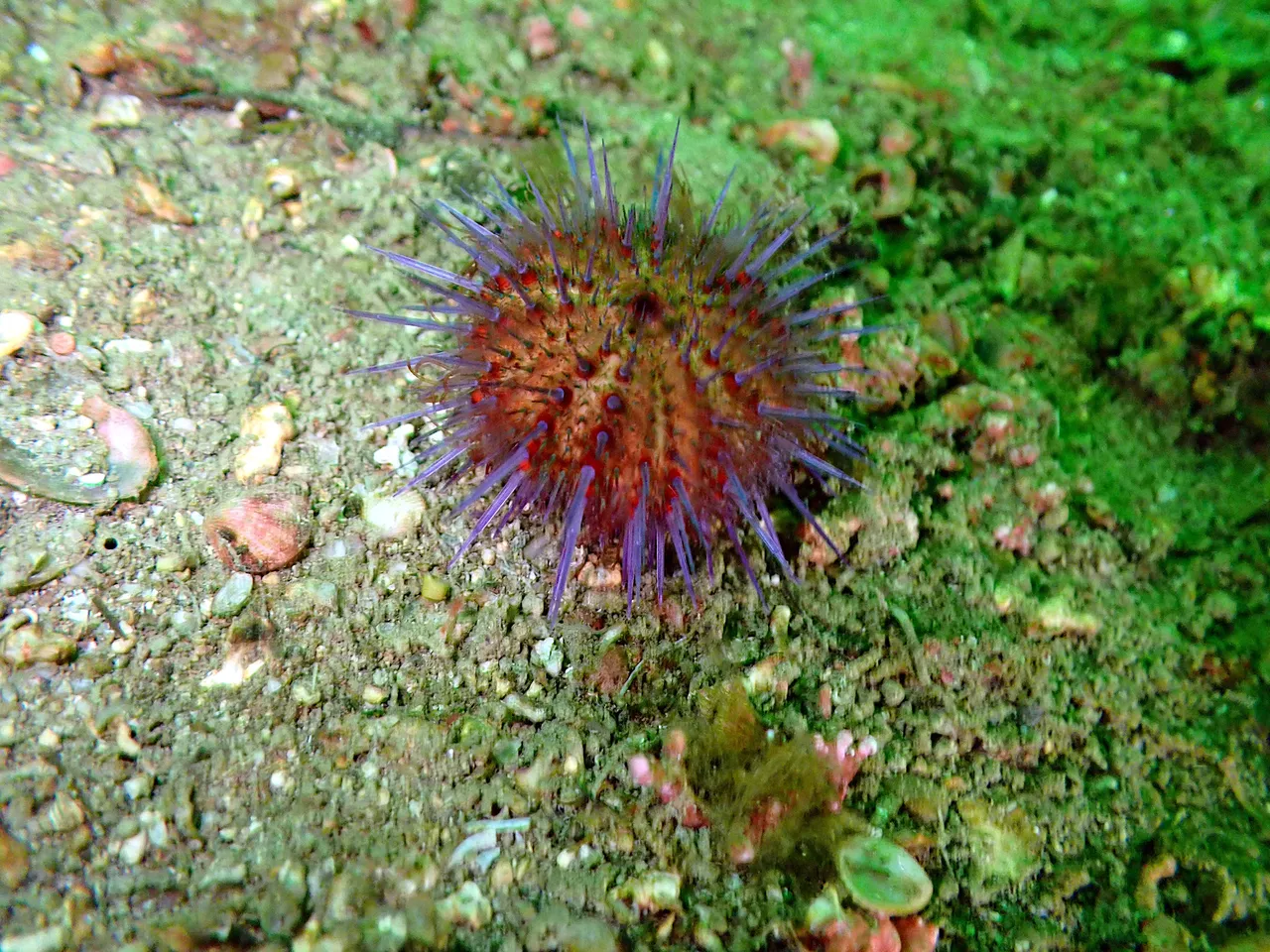
How this was identified, and who took it
Identified by: A flattened globular test of roughly the stated diameter, densely covered in sharp spines of about 1.5 to 3 centimetres, in the purple the page names as most characteristic, over a reddish-brown test. Tube feet are visible between the spines, confirming a live animal rather than a shed test.Sarah Faulwetter — CC BY, via iNaturalist — source, licenceCatching European sea urchin
Everything here on fishing for it. Each entry opens the page behind it.
- Ground
The edible sea urchin is a purple-to-brown globe of spines living in shallow rocky ground, frequently sitting in a hollow it has excavated in the rock itself. It grazes algae with a five-toothed feeding apparatus known as Aristotle's lantern, and in doing so it is one of the principal shapers of Mediterranean shallow reef — where urchin densities are high, the rock is grazed bare into what is called an urchin barren.
What is eaten is not the animal but its five gonads, taken raw or lightly dressed, and they are a delicacy of substantial economic value around the Mediterranean, in Japan and on the Chilean and Californian coasts. That value is the problem. The animals are shallow, immobile, easily located and easily taken by hand or by a free-diver, and populations near population centres have been reduced heavily. Several jurisdictions apply closed seasons, size limits, collection permits and outright bans, and the position changes.
Collection is also the one catch on FishingHQ where the primary handling hazard is the animal's defences rather than its behaviour: the spines break off in skin and are difficult to remove.
Identification
- Scientific name
- Paracentrotus lividus
- Family
- Parechinidae
- Water
- Saltwater
- Conservation status
- Not assessed
- Regions
- Mediterranean, Western Europe, Britain & Ireland, North Africa
- A flattened globe 4–7 cm across the test, densely covered in sharp spines 1.5–3 cm long.
- Colour ranges from deep purple through olive to brown, with purple the most characteristic.
- Five-fold radial symmetry visible on the cleaned test, with the mouth on the underside.
- Frequently found sitting in a shallow excavated hollow in the rock, and often covered in shell fragments and weed it has placed on itself.
- Distinguished from the larger, paler edible urchin Echinus esculentus, which is deeper-water, rounder and pinker with shorter spines.
Size
- Typical
- 4–6 cm test diameter, excluding spines.
- Large
- Over 7 cm.
Exceptional: Test diameters around 8 cm are recorded. Size is measured across the TEST — the shell — and not including the spines, which is the measurement any size limit uses.
Handling urchins: spines that break off, and a decision about how many to take
The sea urchin is the one animal on FishingHQ whose primary handling hazard is a purely passive defence, and the injuries it causes are more often to feet than to hands.
THE SPINES penetrate readily and are brittle enough to snap off beneath the skin, where fragments are difficult to remove and puncture wounds in seawater are prone to infection. Standing on one in shallow water is the usual mechanism, which is why footwear on urchin ground matters more than gloves do — though both are sensible.
Treat a puncture properly rather than assuming a spine will work its way out. Fragments that remain can cause prolonged inflammation, and a wound that is still painful or swelling days later needs looking at.
COLLECTION is by hand or with a simple hook, taking the animal intact off the rock. Where it is done by free-diving, the whole spearfishing safety posture applies without modification: get proper freediving instruction before hunting on breath-hold, dive with a competent buddy on a one-up-one-down rotation, never alone, and surface rather than extend a dive. An urchin is stationary and will still be there on the next breath — there is no catch in the sea less worth pushing a breath-hold for.
WHAT IS EATEN is the five gonads inside the test, reached by cutting the underside open around the mouth and rinsing the gut out. They do not keep: collection and eating happen the same day.
AND THE NUMBER YOU TAKE IS THE REAL DECISION. This species is slow-growing, sedentary, trivially easy to locate and depleted across a large part of its range near population centres. Ground that is cleared does not restock quickly, because it depends on larvae arriving from somewhere else. The gonads are only worth taking for part of the year — the period when they are full is the period immediately before spawning, which is precisely when the animals should be left alone, and closed seasons where they exist usually protect exactly that window.
Several jurisdictions apply closed seasons, minimum test sizes measured across the shell excluding the spines, permit requirements, daily limits and in places outright prohibition, and the position changes. Establish the current rules with the relevant fisheries authority before collecting anything.
ONE THING THIS ANIMAL IS NOT is a filter feeder. An urchin grazes algae off rock, so it does not concentrate algal biotoxins the way a mussel or a cockle does, and the paralytic shellfish poisoning framework does not apply to it in the same way. Ordinary caution about water quality still does.
Backed by research — why, and the sources (2)
Supported by peer-reviewed research or fisheries science. The sources are listed and can be checked.
- FishBase: a global information system on fishes — Froese, R. and D. Pauly, eds. — FishBase Consortium (Scientific institute)Relied on for: Morphology, growth, moult and reproductive biology underlying the handling described, with SeaLifeBase as its sister database for non-finfish taxa.States this directlyPassage read and verified
- Fish and Fishery Products Hazards and Controls Guidance — US Food and Drug Administration, Center for Food Safety and Applied Nutrition, 2022 (Standards body)Relied on for: That bivalve molluscs accumulate biotoxins and microbiological contamination from the growing water, that these are not destroyed by cooking, and that control is by classification and testing of harvesting areas.States this directlyPassage read and verified
The gonad is the product, which is why the season and the spawning are the same thing
Sea urchin reproduction has an unusually direct relationship with the fishery, because the organ that reproduces is the organ that is eaten.
THE PART THAT IS EATEN IS THE GONAD. What is sold as urchin roe — uni — is the reproductive tissue of the animal, of either sex, and nothing else inside an urchin is eaten. That single fact means the harvest is directly coupled to the reproductive cycle in a way almost no other fishery is.
THE CYCLE. Sexes are separate and gametes are released into the water column for external fertilisation, chiefly in spring and again in autumn in much of the range, with the timing driven by temperature and photoperiod. In the run-up the gonads swell substantially, filling the interior of the test; after spawning they are spent, shrunken and watery.
SO THE HARVEST WINDOW IS THE PRE-SPAWNING PERIOD, necessarily. An urchin taken when the gonad is full is worth taking; the same urchin a fortnight later is not. That is why collection is seasonal and why the season is defined by the animal's condition rather than by any culinary convention.
AND IT PRODUCES A GENUINE CONFLICT THAT IS WORTH NAMING PLAINLY. The moment the animals are most worth harvesting is the moment immediately before they reproduce. A fishery operating at peak quality is a fishery removing gametes that were about to be released. That is not true of most fisheries — a cod taken outside its spawning season is still a cod — and it is the structural reason urchin populations have been depleted so rapidly in so many places, including across parts of the Mediterranean where this species is the target.
WHICH IS WHY CLOSED SEASONS FOR URCHINS FREQUENTLY COINCIDE WITH THE SPAWNING PERIOD rather than with any question of taste: the point is to let a proportion of the population actually spawn. That is the reasoning behind such instruments. What is currently in force anywhere — seasons, size limits, quantities, permits, or outright prohibition — is local, changes, and is not stated by this page.
URCHINS ARE ALSO SLOW-GROWING AND LONG-LIVED, and settlement is variable, so a depleted bed does not refill quickly.
Backed by research — why, and the sources (2)
Supported by peer-reviewed research or fisheries science. The sources are listed and can be checked.
- FishBase: a global information system on fishes — Froese, R. and D. Pauly, eds. — FishBase Consortium (Scientific institute)Relied on for: Reproductive mode, spawning season, larval development and condition cycle recorded for the species.States this directlyPassage read and verified
- Good Fish Guide — Marine Conservation Society (Conservation authority)Relied on for: Stock and method assessment for commercially and recreationally taken shellfish, and the conservation measures applied to them.Background and mechanism onlyCitation checked — the work exists and is described correctly
Measured across the test, not the spines — and the size limit is the whole point
Sea urchin size is the clearest case on FishingHQ where knowing what is being measured is more important than knowing the number.
THE MEASUREMENT IS TEST DIAMETER: the width of the shell itself, with the spines excluded. An urchin with its spines can be twice the apparent diameter of its test, so somebody measuring the animal as they see it will overestimate by a wide margin and will believe an undersized urchin is legal. Any minimum size for this species is expressed in test diameter, and this page states it explicitly for that reason.
GROWTH IS SLOW AND THE ANIMAL IS LONG-LIVED. A sea urchin of the 'large' size on this page has been on that ground for a number of years, and the population's size structure accumulates slowly. That is the fact behind the species' vulnerability: urchins are sedentary, easy to find, easy to take, and slow to replace, and heavily gathered grounds show it in their size distribution long before they show it in numbers.
SIZE ALSO TRACKS FOOD AND EXPOSURE. Urchins grazing rich algal ground grow faster than those on barren rock, and populations in sheltered, productive shallows out-grow those on exposed coast. Where urchin grazing has itself removed the algae — the barren state this species can create at high density — growth slows for everything left.
AND SIZE IS NOT THE SAME AS CONDITION, WHICH IS WHAT A GATHERER IS ACTUALLY AFTER. The product is the gonad, and gonad volume varies through the reproductive cycle independently of test diameter. A large urchin taken at the wrong point in the cycle yields very little, and a smaller one in full condition yields more. That decoupling is why the season and the size limit answer different questions.
WHICH LEAVES THE PRACTICAL POSITION: measure the test, use a gauge rather than an eye, and treat any local minimum size, closed period, quota or gathering restriction as the authority. This species is regulated differently across the Mediterranean and Atlantic jurisdictions it occurs in, and FishingHQ does not state what any current rule is.
Official guidance — why, and the sources (2)
Stated by a fisheries authority, scientific institute or recognised angling body. Authoritative, but summarising rather than demonstrating.
- Good Fish Guide — Marine Conservation Society (Conservation authority)Relied on for: Assessment of the stock and the fishery, including growth rate, the size at which the animal is taken, and the sustainability implications of removing large individuals.Background and mechanism onlyCitation checked — the work exists and is described correctly
- FishBase: a global information system on fishes — Froese, R. and D. Pauly, eds. — FishBase Consortium (Scientific institute)Relied on for: Recorded maximum size and growth information for the species.Background and mechanism onlyPassage read and verified
Grazing shallow rock, and an animal that can eat its own habitat
Sea urchin habitat has a feedback loop in it that very few species on FishingHQ have: the animal's grazing determines what its habitat looks like, and at high density it destroys the thing it lives on.
THE GROUND IS SHALLOW ROCK AND SEAGRASS IN CLEAR, MOVING WATER. This urchin occupies rocky reef, boulder, bedrock and cobble from the low intertidal down through the shallow sublittoral, and it also occupies seagrass beds, where it grazes the leaves. It favours moderately exposed to sheltered ground with good water movement and reasonable clarity, and it uses crevices, gullies and holes both as shelter and as a place to wedge itself against surge.
IT MODIFIES ITS OWN REFUGE, LITERALLY. Paracentrotus is a burrowing urchin: it excavates depressions in soft rock with its teeth and spines and sits in them, and on suitable limestone or sandstone the rock becomes pitted with occupied hollows. It also decorates itself with shell fragments, pebbles and weed held in its tube feet, which serves as camouflage and as protection from light and desiccation.
GRAZING IS THE MAIN ECOLOGICAL FORCE AND IT CUTS BOTH WAYS. At moderate density urchins crop algae and maintain a mixed, patchy community. At high density they clear the rock entirely, producing the state usually called an urchin barren: bare rock, encrusting coralline algae, and almost nothing else. Barrens are self-sustaining, because the algae that would recolonise are eaten as they appear. Where urchin predators — certain fish, large crustaceans, and in some systems otters or sea stars — have been reduced, barrens spread.
WHICH MEANS THE HABITAT DESCRIPTION DEPENDS ON WHAT ELSE IS PRESENT. The same coastline can hold kelp forest and urchin barren a few hundred metres apart, and the difference is the density of urchins rather than the physics of the shore.
DEPTH AND EXPOSURE SET THE UPPER AND LOWER LIMITS. Urchins are excluded from the highest shore by desiccation and from heavily wave-battered ground by dislodgement, and they thin out with depth as light and algal food decline.
AND THE GROUND IS THE SAFETY CONSIDERATION FOR ANYBODY GATHERING. Urchin habitat is shallow broken rock in surge — slippery, uneven and awkward — and it is worth saying that the hazard of the habitat considerably exceeds the hazard of the spines. Whether the animal may be taken there at all is a matter for the local competent authority.
Backed by research — why, and the sources (2)
Supported by peer-reviewed research or fisheries science. The sources are listed and can be checked.
- Good Fish Guide — Marine Conservation Society (Conservation authority)Relied on for: Assessment of the stock and the ground it occupies, including habitat, the effect of gathering methods on it, and its sensitivity to disturbance.Background and mechanism onlyCitation checked — the work exists and is described correctly
- The IUCN Red List of Threatened Species — International Union for Conservation of Nature (Conservation authority)Relied on for: Habitat account and the pressures on the habitat the species depends on, where the species is assessed.Background and mechanism onlyCitation checked — the work exists and is described correctly
The gonad cycle is the season, and it is the same organ the animal reproduces with
Sea urchins have the tightest possible link between reproductive biology and harvest value, because the product and the gonad are the same tissue — so the season is the reproductive cycle, read from the outside.
THE CYCLE RUNS ON FEEDING AND THEN ON RIPENING. Through the productive months urchins graze heavily and build gonad tissue; as the reproductive season approaches, that tissue matures. Condition — the proportion of the test filled by gonad, and its texture and colour — rises to a peak and then collapses at spawning, when the gametes are released into the water and the animal is left effectively empty.
SO THERE IS A WINDOW, AND IT CLOSES SHARPLY. Before it, gonad volume is insufficient; at the peak, condition is at its best; after spawning the animal is not worth taking and will not recover until the next cycle. That window shifts by weeks between coasts and between years according to temperature and food supply, and in some populations there is more than one spawning episode per year, which complicates it further.
WATER TEMPERATURE AND DAY LENGTH ARE THE CUES, in the usual combination, which is why the same species ripens at noticeably different times in the Mediterranean and on the Atlantic coast. A season learned in one place is close to useless in another.
FOOD SUPPLY MODULATES ALL OF IT. Urchins on rich algal ground build better gonad than urchins on a grazed barren, so condition varies between grounds a short distance apart within the same season. An urchin's season is partly a property of its patch of rock.
WHICH IS WHY THE SPECIES IS SO EASILY OVERGATHERED. Gathering concentrates on exactly the pre-spawning peak, which is exactly the point at which removing an animal removes its entire reproductive output for that cycle — the most costly possible moment for the population. Slow growth and a sedentary adult life mean grounds do not refill from elsewhere quickly.
AND THE RULES ARE NOT DERIVABLE FROM ANY OF THIS. Closed periods, minimum sizes, quotas, permitted methods and licensing for sea urchins vary substantially between jurisdictions and are frequently set for management reasons that do not align with the condition cycle. The competent authority is the only source, and FishingHQ does not state what any current rule is.
Official guidance — why, and the sources (2)
Stated by a fisheries authority, scientific institute or recognised angling body. Authoritative, but summarising rather than demonstrating.
- Cefas science, advice and data on marine and freshwater environments — Centre for Environment, Fisheries and Aquaculture Science (Government fisheries body)Relied on for: Seasonal condition, reproductive cycle and gathering considerations for shellfish in British and north-west European waters.States this directlyCitation checked — the work exists and is described correctly
- Good Fish Guide — Marine Conservation Society (Conservation authority)Relied on for: Stock and fishery assessment, including the seasonal condition of the animal and the periods of greatest sensitivity.Background and mechanism onlyCitation checked — the work exists and is described correctly
Lifecycle and reproduction
Planktonic larvae drift for several weeks before settling onto shallow rocky ground. Growth is slow and animals live around a decade, reaching harvestable size after several years. Recruitment is highly variable between years and depends on larval supply from elsewhere, so a ground that is cleared does not restock on any short timescale — which is the mechanism behind the depletion recorded across much of the range.
Sexes are separate and gametes are released into the water column, chiefly in spring and again in autumn in much of the range, with the timing driven by temperature and photoperiod. The gonads — the part that is eaten — swell before spawning and are spent afterwards, which is why collection is seasonal and why closed seasons frequently coincide with the spawning period rather than with any culinary preference.
Feeding and senses
A grazer, rasping algae from rock with Aristotle's lantern, the five-toothed jaw apparatus unique to echinoids. Where predators are reduced and densities rise, grazing removes macroalgae entirely and produces urchin barrens — bare rock with a fundamentally different ecology, which is one of the better-documented cascade effects in shallow marine systems.
No eyes and no brain. Light-sensitive cells distributed across the test give a crude directional light sense, and the tube feet and spines respond to touch and to chemical cues. The animal moves slowly on tube feet and holds position strongly against surge.
Through the year
Present year-round and effectively sedentary. What changes seasonally is the gonad, which fills ahead of spawning and is spent afterwards — so the animal is worth collecting for only part of the year, and that period frequently coincides with when it should be left alone. Where a closed season applies it usually protects exactly that window.
Distribution
Throughout the Mediterranean and along the eastern Atlantic from Ireland and western Britain south to Morocco and the Canaries. Shallow rocky ground, seagrass margins and boulder fields from the low intertidal down to around twenty metres, with the greatest densities in the shallow sublittoral.
This is a biological range — where the species occurs, not a prediction that you will catch one. To browse the fishing geography FishingHQ holds, start at fishing places.
Why anglers care
Collected by hand at low water and by free-divers, and a traditional food across the Mediterranean with a substantial commercial fishery behind it. For an angler the animal matters mainly as habitat context: urchin barrens hold a different and poorer fish community than grazed-but-vegetated reef, and the difference is visible underwater.
Handling and returning
THE SPINES ARE THE HAZARD. They are sharp, they penetrate readily, and they are brittle enough to break off beneath the skin where they are difficult to remove and prone to infection. Hands and, more commonly, feet: standing on one in shallow water is the usual mechanism. Wear gloves for collection and footwear on urchin ground, and treat a puncture properly rather than ignoring it.
COLLECTION is by hand or with a simple hook, taking the animal off the rock intact. Free-divers working urchin ground should be under the same posture as any other breath-hold activity — get proper instruction, dive with a competent buddy, never alone, and surface rather than extend a dive for an animal that is not going anywhere.
TAKE VERY LITTLE. This species is slow-growing, sedentary, easily located and depleted across a large part of its range. A ground that is cleared does not restock quickly because it depends on larvae arriving from elsewhere. Several jurisdictions apply closed seasons, minimum test sizes, permit requirements, daily limits and in places outright prohibition — and the position changes. Establish the current rules with the relevant fisheries authority before collecting anything.
WHAT IS EATEN is the five gonads inside the test, reached by cutting the underside open around the mouth and rinsing out the gut. They are eaten raw or barely dressed and they do not keep — collection and eating are the same day.
AND THE SAFETY FRAMEWORK IS NOT THE BIVALVE ONE. An urchin grazes rather than filters, so it does not concentrate algal biotoxins in the way a mussel does. Ordinary caution about water quality applies; the paralytic shellfish poisoning framework does not apply in the same way.
Safety
Shallow water blackout and breath-hold loss of consciousness is set out at the top of this page, where it cannot be missed.
Tides and being cut off — Can cause serious injury or death
Gathering happens on intertidal ground at low water, facing down, with attention on the beach rather than the sea. Flats and gullies flood from behind, and people have drowned on ground they walked out over an hour earlier.
What reduces it: Know the tide and the exit before starting, and set a time to leave rather than leaving when the bag is full. Do not gather alone on unfamiliar intertidal ground, and tell somebody where you are.
Venomous and spined species — Can cause injury needing treatment
Spines penetrate skin readily and break off beneath it, where fragments are difficult to remove and puncture wounds in seawater are prone to infection. Most injuries are to feet in shallow water rather than to hands.
What reduces it: Gloves for collection, footwear on urchin ground, and looking before placing a hand or foot. Treat punctures properly and watch them; do not assume a broken spine will simply work its way out.
Precautions that always apply here
- Check the tide before you go and know your exit route. Being cut off is the commonest way a shore session becomes a rescue.
- Never spearfish or freedive alone.
- Dive one up, one down: one diver down, one on the surface actively watching, every single dive.
- Tell somebody where you are going and when you expect to be back.
Check the rules before you fish
Fishing laws, bylaws, access rules, seasons, bait restrictions and permitted methods vary by location and can change. Check the current rules from the relevant authority and the water you intend to fish before fishing.
Check with:
- Current national or regional law for where you are fishing
- Current local bylaws
- The relevant fisheries authority
- The landowner, club or fishery whose water it is
- Any restrictions specific to the species or the method you intend to use
Where to go next
Where it lives
Rules and access
More fish
Not related to this page — just the rest of the section. There is little else joined to this subject yet, and a short page should still lead somewhere.
Sources and evidence
- FishBase: a global information system on fishes — Froese, R. and D. Pauly, eds. — FishBase Consortium (Scientific institute)Relied on for: Taxonomy, distribution, habitat association, growth and reproductive biology for the species, with SeaLifeBase as its sister database for non-finfish taxa.States this directlyPassage read and verified
Why the 3 connections on this page are here, and the sources
How it is caught
Official guidance — 1 connection
Stated by a fisheries authority, scientific institute or recognised angling body. Authoritative, but summarising rather than demonstrating.
Gathering winkles, whelks and limpets
The species page describes collection by hand at low water and by free-divers. The low-water hand collection is surface gathering from rock, which is the existing method; the free-diving collection is a different technique and is deliberately not claimed here.
- Recreational fishing and the shellfish permit — North Eastern IFCA — North Eastern Inshore Fisheries and Conservation Authority (Government fisheries body)Relied on for: An English inshore fisheries authority's own recreational shellfish permit and the byelaws around it, as an instance of the district-by-district regulation of hand gathering.States this directlyPassage read and verified
- Shellfish classification — Food Standards Agency, 2026 (Government fisheries body)Relied on for: The existence of an official classification and monitoring regime for shellfish harvesting areas, and the body that administers it.States this directlyCitation checked — the work exists and is described correctly
Where it lives
Backed by research — 1 connection
Supported by peer-reviewed research or fisheries science. The sources are listed and can be checked.
Rocky shores and reefs
Habitat association recorded for the species rather than inferred from the fishery.
- FishBase: a global information system on fishes — Froese, R. and D. Pauly, eds. — FishBase Consortium (Scientific institute)Relied on for: Habitat association, depth range and distribution for the species, with SeaLifeBase as its sister database for non-finfish taxa.States this directlyPassage read and verified
A claim that a place contains the ground and conditions the animal is associated with. It is a distributional statement about the world and rests on reference works, and it deliberately asserts nothing about access or permission.
- The Fishes of the British Isles and North-West Europe — Macmillan, 1969 (Reference work)Relied on for: Distribution and habitat association of the inshore fauna of the British Isles and the north-east Atlantic.States this directlyCitation checked — the work exists and is described correctly
- FishBase: a global information system on fishes — Froese, R. and D. Pauly, eds. — FishBase Consortium (Scientific institute)Relied on for: Recorded distribution and habitat association for the species where held.Background and mechanism onlyPassage read and verified
- The IUCN Red List of Threatened Species — International Union for Conservation of Nature (Conservation authority)Relied on for: Range and recorded threats for the species where assessed.Background and mechanism onlyCitation checked — the work exists and is described correctly
Rules and access
Official guidance — 1 connection
Stated by a fisheries authority, scientific institute or recognised angling body. Authoritative, but summarising rather than demonstrating.
Taking crabs, lobsters, squid and shellfish: how the rules are structured
The regulatory framework that applies to taking this animal at all.
- Code of Conduct for Responsible Fisheries — Food and Agriculture Organization of the United Nations, Rome, 1995 (Standards body)Relied on for: That size limits, closed seasons and collection permits are standard instruments of fisheries management.States this directlyCitation checked — the work exists and is described correctly
How FishingHQ labels evidence is explained in the evidence policy.