Blue cod
Fish · Last reviewed 2026-08-10
A New Zealand endemic reef fish that changes sex from female to male and shifts colour with it, territorial, curious and heavily fished.
Safety: barotrauma and pressure injury — can cause injury needing treatment.
Barotrauma and pressure injury — Can cause injury needing treatment
Fish taken from deeper rocky ground suffer swim bladder expansion and cannot return to the bottom unaided.
What reduces it: Carry a descending device when fishing deeper ground and use it for released fish.
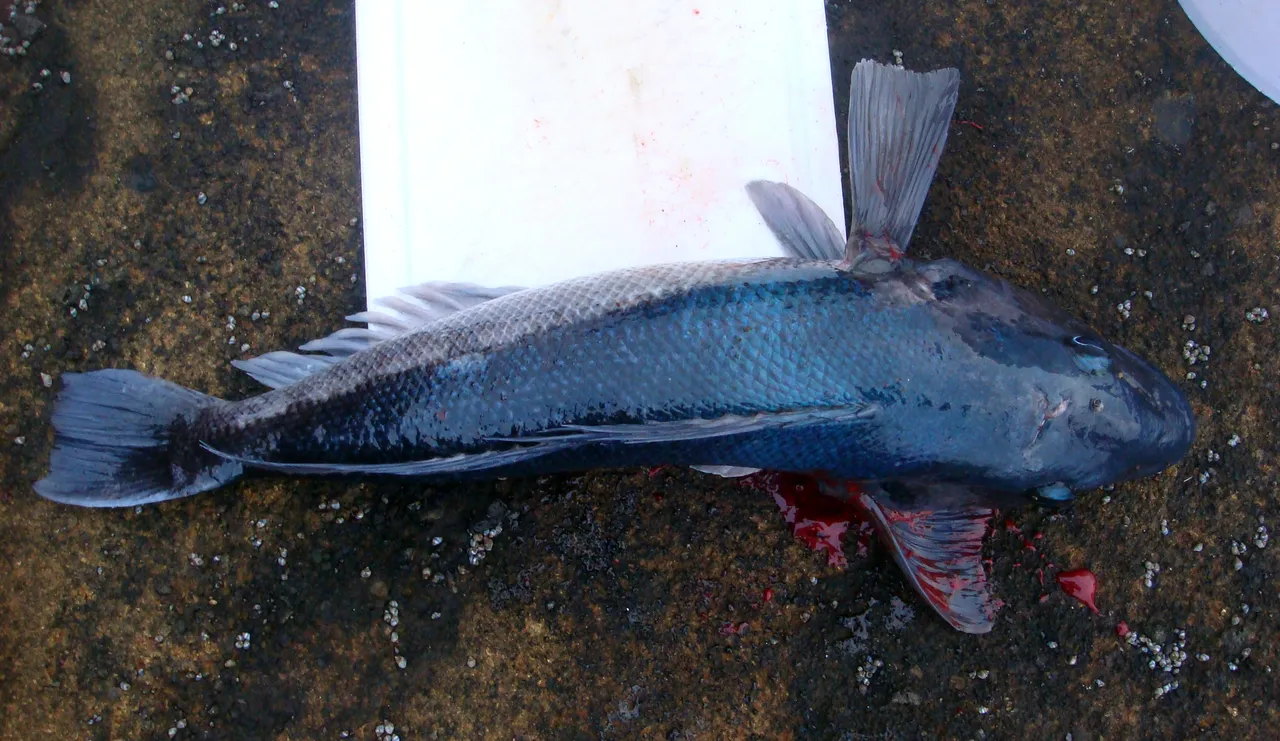
How this was identified, and who took it
Identified by: All three characters clear: a blunt rounded head with thick lips and a large mouth, eyes set conspicuously high on the head, and a single long-based dorsal running the length of the back to a squarely truncate tail. The blue-grey dorsal surface over paler underparts matches the record's darker phase.Peter de Lange — CC0, via iNaturalist — source, licenceCatching Blue cod
Everything here on fishing for it. Each entry opens the page behind it.
Blue cod is a New Zealand endemic and one of the country's most important recreational species. It is not a cod at all — it belongs to the sandperches — and it lives on rocky and mixed ground around the South Island and Stewart Island in particular.
Its life history is unusual and directly relevant to how it is managed. Blue cod change sex from female to male as they grow, and they change colour as they do: young fish and females are pale blue-grey to greenish, while large territorial males become dark blue-black with white underparts.
They are territorial, site-faithful and notably unafraid, which makes them easy to catch and makes local depletion around accessible ground a genuine and documented problem.
How it is caught
Identification
- Scientific name
- Parapercis colias
- Family
- Pinguipedidae
- Water
- Saltwater
- Conservation status
- Least Concern
- Regions
- New Zealand
- Large territorial males dark blue-black above with white underparts; females and juveniles pale blue-grey to greenish with mottling.
- Blunt rounded head with thick lips and a large mouth, and eyes set high.
- A single long-based dorsal fin and a squared-off tail.
- Robust, slightly elongate body with no barbels.
Size
- Typical
- 0.5–1.5 kg (1.1–3.3 lb)
- Large
- 2–3.5 kg (4.4–7.7 lb)
Exceptional: FishBase records a maximum of 45 cm and 2.5 kg
How blue cod are fished, and why
A curious, aggressive, strongly bottom-associated fish of southern inshore reef, and the methods exploit a fish that comes to investigate rather than one that has to be found.
LEDGERING is the mainstay: a bait on the bottom over reef and broken ground, where the fish lives and feeds on crustaceans, molluscs and small fish.
JIGGING works because blue cod will attack a moving lure aggressively at close range, and because a jig fishes the same vertical ground a bait does without the same snagging cost.
DIVING is a recognised method, again for a fish that holds on structure and can be selected.
THE MANAGEMENT POINT IS INSEPARABLE FROM THE METHOD. Blue cod are territorial, site-attached and easily depleted locally, and their willingness to approach is precisely what makes that possible. Size and bag limits and area closures exist for that reason and are actively varied; check the current position before keeping any.
What experienced anglers do — why, and the sources (2)
Widely and independently recommended by experienced anglers and specialist sources. This is real angling knowledge, not proof: controlled evidence for it is limited, and FishingHQ records it as convention rather than as a demonstrated effect.
- FishBase: a global information system on fishes — Froese, R. and D. Pauly, eds. — FishBase Consortium (Scientific institute)Relied on for: Habitat association, depth range, feeding ecology and prey of the species, from which the method association follows.Background and mechanism onlyPassage read and verified
- IGFA International Angling Rules and World Record Requirements — International Game Fish Association (Angling or fisheries organisation)Relied on for: Recognised angling methods and the tackle classes used for them internationally.Background and mechanism onlyPassage read and verified
Why returning an undersized blue cod to the same rock is the whole management system
Blue cod handling is unusually consequential for a fish that presents almost no hazard to the angler, and the reason is that the species' biology makes the release decision a management decision.
BLUE COD ARE SITE-ATTACHED. They occupy and defend small areas of rocky ground and move very little through their lives. That has two consequences that anglers meet directly. The first is that a productive patch of ground can be fished out locally and stay fished out, because there is no reservoir of fish moving in from elsewhere to refill it — recovery depends on recruitment rather than on immigration, and it is slow. The second is that a fish returned in good condition goes back to the same ground it was taken from, which is precisely why the area-based management used across New Zealand works at all.
SO THE RETURN HAS TO ACTUALLY WORK, and the thing that stops it working is depth. Blue cod off deeper rocky ground arrive with an expanded swim bladder and cannot swim down. A fish that is floating on the surface after release is not contributing to the population it was returned to; it is feeding a gull. A descending device converts a nominal release into a real one, and on this species — where the whole management model assumes returned fish go back to the ground — that difference is the difference between a rule that works and a rule that is observed.
THE SPECIES IS ALSO A PROTOGYNOUS HERMAPHRODITE in the same way black sea bass are, with larger fish disproportionately male, which is a further argument for returning the big ones rather than the small ones.
Beyond that the fish is easy: no meaningful spines, no dentition worth worrying about, wet hands, support the body, and back quickly.
Official guidance — why, and the sources (2)
Stated by a fisheries authority, scientific institute or recognised angling body. Authoritative, but summarising rather than demonstrating.
- FishBase: a global information system on fishes — Froese, R. and D. Pauly, eds. — FishBase Consortium (Scientific institute)Relied on for: Morphology, dentition, spination, thermal tolerance, reproductive strategy and depth range recorded for the species.States this directlyPassage read and verified
- The IUCN Red List of Threatened Species — International Union for Conservation of Nature (Conservation authority)Relied on for: Assessment, population trend and the life-history traits — longevity, growth rate, sex structure — that determine a population's sensitivity to the removal of large individuals.Background and mechanism onlyCitation checked — the work exists and is described correctly
Lifecycle and reproduction
Slow-growing, long-lived and protogynous — most fish mature as female and change to male with size, so the large fish in a population are the males. Site fidelity means local populations do not readily replenish from elsewhere.
Spawns in spring and summer over rocky ground. Because sex change is size-related and populations are site-faithful, removing large fish removes males from a specific patch of ground rather than from a mixing population.
Feeding and senses
Takes crustaceans, small fish, worms and molluscs from and around rocky and mixed ground, feeding actively during daylight.
A daylight visual predator that investigates disturbance readily — the curiosity that makes it easy to catch is the same trait that makes it vulnerable to concentrated fishing.
Through the year
Resident on ground year-round with limited movement, which is precisely why local depletion occurs and why area-based management is used.
Distribution
Southwest Pacific: restricted to New Zealand
This is a biological range — where the species occurs, not a prediction that you will catch one. To browse the fishing geography FishingHQ holds, start at fishing places.
Why anglers care
One of New Zealand's most important recreational species, taken on bait and jigs over rocky and mixed ground from small boats, and a common spearfishing target. Its significance is eating quality and accessibility, and its site fidelity has made it a focus of area closures and rotational management. FishingHQ does not state what any rule is; blue cod rules differ substantially between New Zealand regions and change.
Handling and returning
Robust but subject to barotrauma from deeper ground. Use a descending device where fish are returned from depth, handle with wet hands, and be aware that returning undersized fish to the same patch of ground is what area management depends on.
Safety
Barotrauma and pressure injury is set out at the top of this page, where it cannot be missed.
Where to go next
Where it lives
More fish
Not related to this page — just the rest of the section. There is little else joined to this subject yet, and a short page should still lead somewhere.
Sources and evidence
- FishBase: a global information system on fishes — Froese, R. and D. Pauly, eds. — FishBase Consortium (Scientific institute)Relied on for: Family, maximum size, depth and environment, distribution and the IUCN assessment for Parapercis colias.States this directlyPassage read and verified
- The IUCN Red List of Threatened Species — International Union for Conservation of Nature (Conservation authority)Relied on for: The Least Concern assessment for Parapercis colias, assessed 04 February 2009.States this directlyCitation checked — the work exists and is described correctly
Why the 6 connections on this page are here, and the sources
How it is caught
What experienced anglers do — 3 connections
Widely and independently recommended by experienced anglers and specialist sources. This is real angling knowledge, not proof: controlled evidence for it is limited, and FishingHQ records it as convention rather than as a demonstrated effect.
Boat diving
A practitioner claim about how Parapercis colias is commonly fished, following from where and how it feeds.
- General angling website restatements of established technique — Various (Credible secondary source)Relied on for: Widely restated practitioner accounts of fishing for blue cod.Citation checked — the work exists and is described correctly
- Sea Angler — Bauer Media (Specialist angling publication)Relied on for: Practitioner treatment of the methods used for blue cod and comparable species.Citation checked — the work exists and is described correctly
Jigging
A practitioner claim about how Parapercis colias is commonly fished, following from where and how it feeds.
- General angling website restatements of established technique — Various (Credible secondary source)Relied on for: Widely restated practitioner accounts of fishing for blue cod.Citation checked — the work exists and is described correctly
- Sea Angler — Bauer Media (Specialist angling publication)Relied on for: Practitioner treatment of the methods used for blue cod and comparable species.Citation checked — the work exists and is described correctly
Ledgering
A practitioner claim about how Parapercis colias is commonly fished, following from where and how it feeds.
- General angling website restatements of established technique — Various (Credible secondary source)Relied on for: Widely restated practitioner accounts of fishing for blue cod.Citation checked — the work exists and is described correctly
- Sea Angler — Bauer Media (Specialist angling publication)Relied on for: Practitioner treatment of the methods used for blue cod and comparable species.Citation checked — the work exists and is described correctly
Gear for this fish
What experienced anglers do — 1 connection
Widely and independently recommended by experienced anglers and specialist sources. This is real angling knowledge, not proof: controlled evidence for it is limited, and FishingHQ records it as convention rather than as a demonstrated effect.
Soft plastics
A practitioner claim about which lure family answers this species' feeding or holding behaviour.
- IGFA International Angling Rules and World Record Requirements — International Game Fish Association (Angling or fisheries organisation)Relied on for: Recognition of the species as an established sport fish taken on artificial lures, and the line and tackle classes used for it.States this directlyPassage read and verified
- General angling website restatements of established technique — Various (Credible secondary source)Relied on for: Widely restated lure practice for this species.Background and mechanism onlyCitation checked — the work exists and is described correctly
Where it lives
Backed by research — 2 connections
Supported by peer-reviewed research or fisheries science. The sources are listed and can be checked.
Inshore ground
A habitat association for Parapercis colias taken from the environment and distribution data on its FishBase summary.
- FishBase: a global information system on fishes — Froese, R. and D. Pauly, eds. — FishBase Consortium (Scientific institute)Relied on for: The environment, depth range and habitat description recorded for Parapercis colias.States this directlyPassage read and verified
Rocky shores and reefs
A habitat association for Parapercis colias taken from the environment and distribution data on its FishBase summary.
- FishBase: a global information system on fishes — Froese, R. and D. Pauly, eds. — FishBase Consortium (Scientific institute)Relied on for: The environment, depth range and habitat description recorded for Parapercis colias.States this directlyPassage read and verified
How FishingHQ labels evidence is explained in the evidence policy.